Safety & Risks
Why an Oven Smells of Burning, and Which Smells Matter
Identify the smell, because they mean different things. Hot dust and a slightly sharp, dry smell on a new oven or one unused for months is manufacturing residue and dust burning off, and it goes after a few heats. A smell of burning food, or smoke, is residue on the cavity floor or on an element and it clears with cleaning. A faintly acrid smell after a heavy clean is cleaner residue burning off, which is why the first heat after cleaning should be with the kitchen ventilated. But burning plastic, burning rubber and the smell of hot wiring are electrical, and those mean stop: switch the range off at the breaker and do not use it until it has been looked at. On this make there is one documented condition worth knowing here — La Cornue's own guide says that if the fascia becomes excessively hot in use the cooling fan may have failed, which is a component that stopped rather than a smell to live with.
The full guide
Why does my oven smell like burning? Seven phrasings, and they are not the same question
People search for this in at least seven ways — burning, burning plastic, burning metal, burning rubber, burning wires, burning when it is turned on, burning after cleaning — and the different words are doing real work. The smell is the diagnosis.
So this page is organized by smell rather than by cause.
Harmless: sharp, dry, dusty
A new oven, or one that has stood unused for months. Manufacturing residue on elements, dust on surfaces, oil films from assembly. The first few heats burn it off, it smells sharp and dry, and then it stops.
That second case is more common here than most places. A second home closed up for four months in the Florida heat comes back to a range that has been sitting, and the first heat of the season smells like something is wrong. It usually is not.
Run it empty at a moderate temperature for half an hour with the windows open, and it will be gone.
Ordinary: smoke, or burnt food
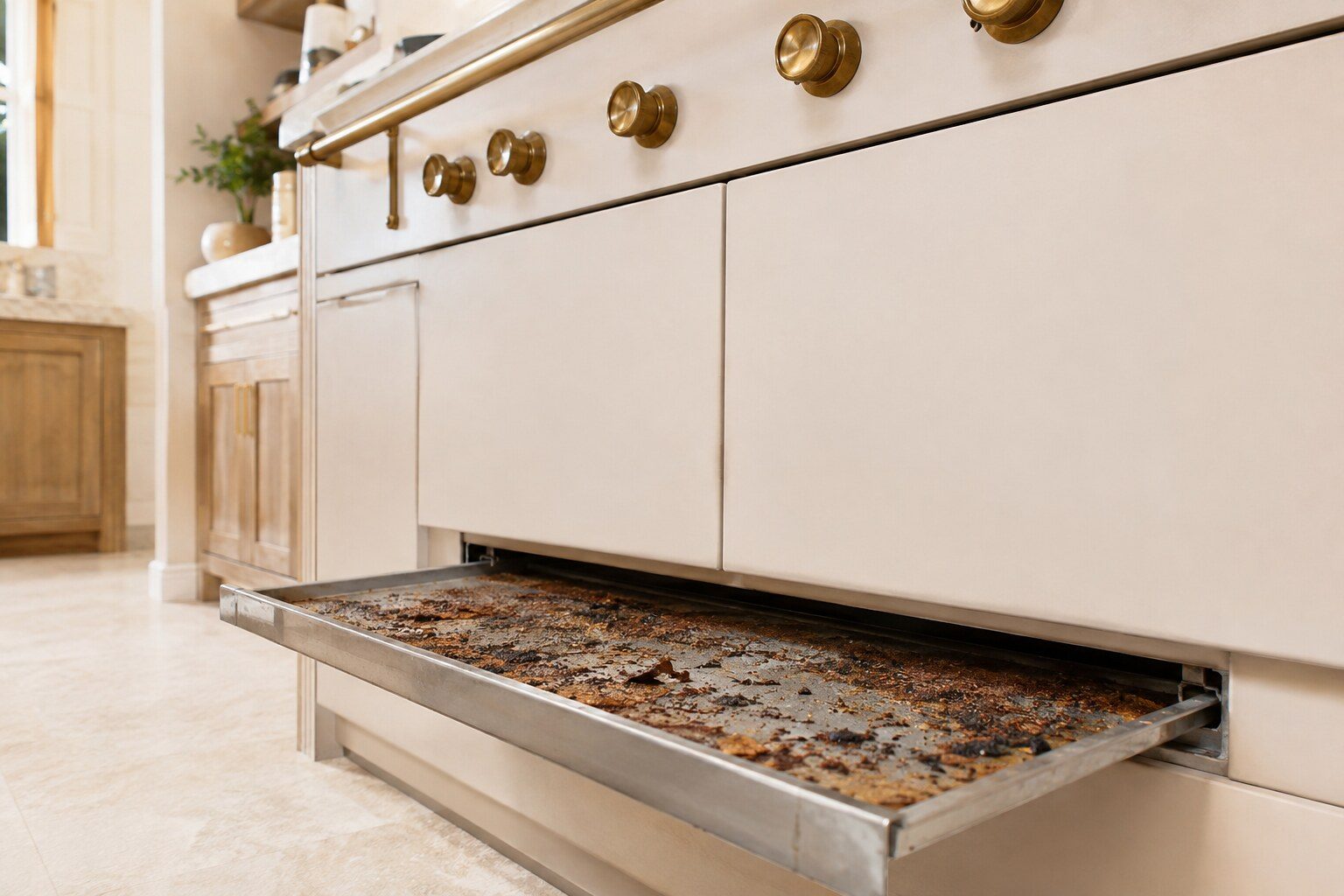
Something is on a heating surface. Spilled fat on the cavity floor, a drip that has carbonised, residue baked onto a broil element, or — on the gas side — something in the burner area.
This is cleaning rather than repair, and the page on cleaning a La Cornue oven covers the method: warm cavity, warm water and soap, bicarbonate paste on anything baked hard, and nothing caustic or abrasive because the surface is enamel.
The tell is that it smells of *food* rather than of *materials*. Once you have noticed that distinction it is hard to unnotice.
Ordinary but worth managing: acrid, after cleaning
Cleaner residue baking out. It gets into seams, under the door seal and behind trim where a cloth cannot reach.
It is one of the reasons La Cornue's own cleaning notes say it does not recommend corrosive or caustic cleaners. Beyond the damage they can do to the finish, they leave residue that comes out of the appliance over several heats and into whatever you are cooking.
Ventilate the kitchen for the first heat after any clean, and rinse more thoroughly than feels necessary.
Stop: plastic, rubber, hot wiring
This is the group that matters, and the response is the same for all three.
Switch the range off at the breaker. Do not use it until it has been looked at.
Burning plastic or rubber in an appliance is insulation, a connector, a wire sheath or a component housing. The smell of hot wiring is unmistakable once you have met it — sharp, metallic-chemical, and quite unlike food.
None of those improves by being run again, and all of them get worse. It is not an emergency in the way a gas smell is — you do not need to leave the house — but it is not something to cook around either, and "it only does it on the broiler" is not reassurance.
Where these come from on this make: a terminal block that has been heating and cooling at a connection for twenty years, an element that has failed at its terminal, a lamp socket that has degraded, or on the electronic platforms a component on a control board.
The one condition the maker documents here
Worth knowing because almost nobody does.
La Cornue's own troubleshooting section says that the range is cooled by a fan, and that if the fascia becomes excessively hot when the range is in use, the cooling fan may have failed — and it directs the owner to arrange repair.
That is a specific, documented component failure behind a symptom most people would put up with. And it matters: the fan is there to protect the controls behind the fascia, so a range running hot at the panel is running its own electronics above where they were meant to sit.
Note the distinction, because the same guide covers both. Warm knobs are normal — heat rises from the oven, and the maker's instruction is not to leave the oven door open. An excessively hot fascia is not.
Hot fascia plus a smell is a combination to have looked at.
What to tell us
Four things, and they narrow it a long way:
- which smell — food, dust, plastic, rubber, wiring;
- when — at switch-on, during preheat, only on broil, only after cleaning;
- whether it is new, and whether the range has been standing unused;
- and whether the fascia or the knobs are hotter than they used to be.
With those we can usually tell you on the phone whether it is a cleaning job, an element, or something we would rather you stopped using tonight.
If it turns out to be a repair
What this leads to, and what it costs
Every job on this site is priced the same way: an on-site diagnostic first, the figure agreed in writing before anybody starts.
-
Ovens
There are three different ovens on this make and they fail in three different ways. The vaulted gas oven cooks by radiant heat inside a sealed dome and has an electric broiler over it. The vaulted electric oven sits on the other side of the same range. And since 2025 there is a standalone one: the Château Tourelle, a fully electric multifunction wall oven in 60 and 75 centimeter widths, built to sit in a cabinet run next to a Château cooktop. Which of the three you have decides everything about the repair.
- Vaulted gas, vaulted electric and the electric Tourelle wall oven
- Gas ovens carry an electric broiler — browning and baking can fail separately
- Thermostat drift is measured against a probe, never adjusted by feel
-
Oven element and broiler replacement
Every vaulted gas oven on this make carries an electric broiler above it, and the electric ovens are elements throughout. That means a range can lose browning and keep baking perfectly, or the reverse, and the two are separate parts.
- Bake and broil are separate circuits and separate failures
- Elements measured cold and under load
- Element supports and terminals checked, because that is where they burn out
-
La Cornue range: an unusually hot fascia points at the range’s cooling fan, and that is a repair
La Cornue — an indicator rather than a code. This is the most specific and least known entry in the whole of La Cornue's troubleshooting section, and it is worth reading before you decide a hot control panel is normal.
What the machine is telling you -
Appliance control board repair
Only part of this make has electronics at all, and where it does — induction generators, multifunction oven controls, the Tourelle, motorized hood controls — a board is the last suspect rather than the first. An Er code and a measured failure send us here; an unexplained symptom does not.
- Supply, sensors and loads eliminated before a board is blamed
- Er numbers documented and quoted, since only the maker's own board clears them
- Lead time stated up front on a hand-built appliance
Questions people ask about this
It smells of burning every time I turn it on, but only for a few minutes.
On a new oven, or one that has stood unused for months, that is dust and residue and it fades over the first few uses. If it has been happening for a year, it is not that: something is on a heating surface — spilled fat on the cavity floor, or residue baked onto an element — and it wants cleaning rather than tolerating.
Ours smells of burning plastic when it heats up.
Stop using it and switch the range off at the breaker. Burning plastic in an appliance is insulation, a connector or a wire, and none of those improves by being run again. It is not an emergency in the gas sense — you do not need to evacuate — but it is a same-week call and it is not something to cook around.
Why does it smell after I clean it?
Cleaner residue burning off. It is one reason La Cornue's own notes say it does not recommend corrosive or caustic cleaners: those leave residue in seams and under seals where a cloth cannot reach, and it bakes out over several heats. Ventilate the kitchen for the first heat after any clean, and rinse more thoroughly than feels necessary.
The knobs and the panel are hot as well as smelling.
The knobs getting warm is normal — the maker confirms it, and its instruction is not to leave the oven door open. An excessively hot fascia is different, and its guide attributes that specifically to a failed cooling fan. Hot plus a smell is a combination to have looked at rather than lived with, because the fan is there to protect the controls behind that panel.
Safety & Risks
More guides like this one
-
A Gas Smell From the Oven: What Is Normal and What Is Not
A brief smell as gas reaches a burner before it lights is ordinary. A smell after the flame is established, or with everything off, is not. Here is the line between them.
Read more -
A Grease Fire on the Cooktop: Four Things, In Order
Never water. Cut the heat, cover the pan, leave it covered, and get out if it has left the pan. Written for a range with a 22,000 BTU burner and a lava-rock grill under a 600 CFM hood.
Read more
Tell us the model number and what it is doing.
This article is based on:
- Official manufacturer documentation
- Internal repair procedures
- Technician repair history
- Company quality standards