
Safety & Risks
A Gas Smell From the Oven: What Is Normal and What Is Not
A brief smell for a second or two as gas reaches a burner before it ignites is ordinary — that is unlit gas doing what unlit gas does for a moment. Everything else is not. A smell that continues for several seconds, a smell after the flame is established and burning steadily, a smell from a burner nobody has touched, or any smell with the range switched off is a leak or a valve passing, and it is not something to investigate yourself. If you can smell gas with everything off, or the smell is strong, or you feel unwell: turn the range off at its shut-off valve if you can reach it safely, open windows and doors, do not operate switches, the hood, or a phone in the room, leave, and call the gas utility or 911 from outside. Call a repair company second. A faint momentary smell on ignition is worth mentioning at your next service; a persistent one is an emergency.
The full guide
Gas smell from oven when preheating: the line, stated plainly
Ordinary: a smell of gas for one or two seconds as a burner lights. Gas arrives at the burner slightly before the spark ignites it. Every gas appliance does this and always has.
Not ordinary, and worth booking: a smell lasting several seconds on ignition. That is a burner lighting slowly, and slow ignition is a problem with a short list of causes — a weak igniter, a dirty electrode, blocked ports.
Not ordinary, and urgent: a smell after the flame is established and burning steadily. A smell from a burner nobody has touched. Any smell with the range switched off. Any smell that is strong, or that makes anyone feel unwell.
The last group is a leak or a valve passing with its knob off, and neither is something to investigate yourself.
What to do, in order
If it is in the urgent group:
1. Shut the gas off at the appliance valve — only if you can reach it safely and without moving anything.
2. Open windows and doors on your way out.
3. Do not operate anything electrical. Not a light switch, not the hood, not the extractor, not a phone in the room. A switch makes a small spark by design.
4. Leave. Take everyone with you.
5. Call the gas utility or 911 from outside.
6. Call us second. The utility's job is to isolate and make safe. Ours is to find and fix. Those are different jobs and they happen in that order.
That sequence is not dramatic. It is what the smell exists for: gas is odorised specifically so a leak is noticed by nose, and the correct response to noticing one has never been to work out where it is coming from.
Why the oven version is worse than the cooktop version
A surface burner puts its gas into an open room above a visible flame. You know within a second whether it is burning.
A vaulted gas oven has no window — the door is part of the cooking mass — and it is a sealed insulated cavity behind a heavy door. It holds whatever it is given.
So a smell of gas during preheat means one of two things, and both are serious: the burner has gone out and gas is still flowing, or ignition is failing while gas is being delivered. The safety valve exists to prevent exactly that, and a smell suggests it is not doing so reliably.
Turn it off. Do not try again. This is the one appliance on the site where we say the limit is zero further attempts rather than two.
What we find when we come
The whole gas train is leak-tested with instruments and a test solution: every joint from the shut-off to each burner, the manifold, the oven feeds, and the plaque and grill burners that nobody uses.
The commonest findings:
A joint disturbed during other work. A kitchen remodel, a floor replaced, the range moved. It dates from a specific day.
A valve passing with its knob off. The one internal problem that produces a smell with everything switched off. That valve comes out; it is not adjusted.
A burner that has gone out. On an oven with no window, an extinguished burner announces itself by smell rather than by sight.
Unlit gas from repeated attempts. Not a leak, the same smell, and the reason every page on this site says two attempts and stop.
Nothing gets signed off because the smell has gone. It gets signed off on a test.
Two smells that are not gas
Hot dust and manufacturing residue. A new oven, or one unused for months — which in a house closed for the season is common here — smells sharp for the first few heats. Unpleasant, not dangerous, and it goes.
Hot plastic, hot rubber or hot wiring. A different emergency with a different response: switch the range off at the breaker rather than the gas valve, and do not use it. That has its own page.
If you genuinely cannot tell which you are smelling, treat it as gas. Ventilating a room unnecessarily costs you nothing.
And the thing worth saying to a repair company
If you have had a momentary smell on ignition for weeks and it is getting longer, say so when you book something else. It is not an emergency and it is a clear signal: a burner taking longer and longer to light is an igniter or an electrode on its way out, and catching it as a booking rather than as a call-out is entirely within your control.
If it turns out to be a repair
What this leads to, and what it costs
Every job on this site is priced the same way: an on-site diagnostic first, the figure agreed in writing before anybody starts.
-
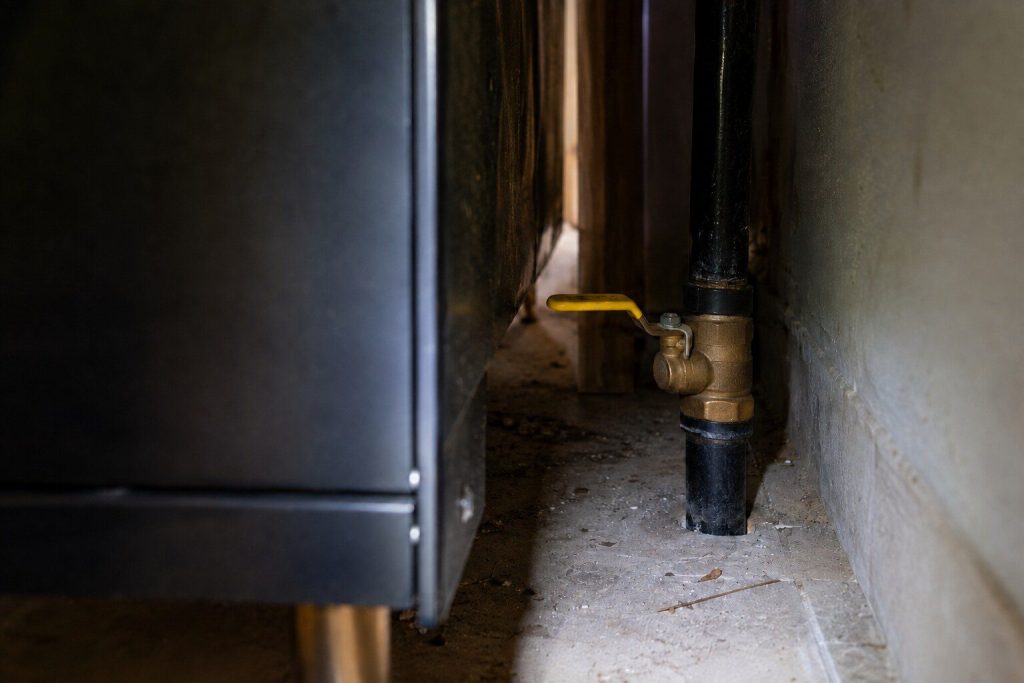
Stop and read this first Gas smell in the kitchen
A smell of gas is the one symptom on this site with instructions rather than a diagnosis. Turn the range off at its shut-off valve, open windows, do not operate switches or the hood, and get everyone out if the smell is strong. Then call the gas utility or 911 first and us second.
- Utility or 911 first, appliance repair second
- Do not operate switches, the hood or a phone in the room
- A faint smell only while lighting is a different matter from a persistent one
-
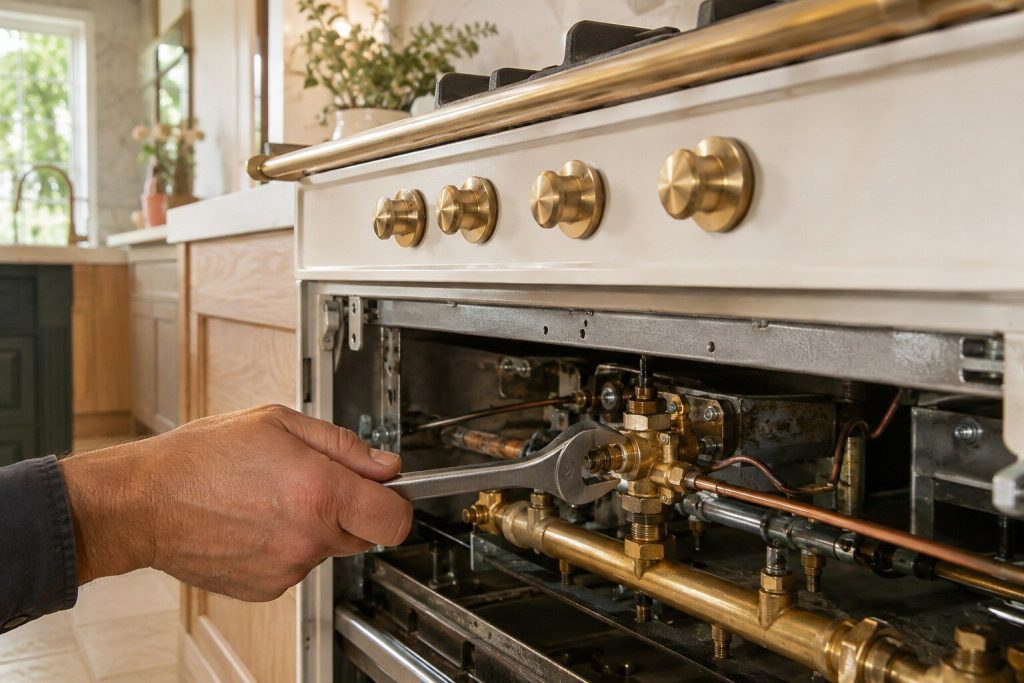
from $265 Gas valve and thermocouple repair
The safety chain: a valve that will not hold open, a thermocouple that no longer tells it to, a knob that has gone stiff or will not shut off cleanly. This is the part of a gas range where nothing gets improvised and nothing gets left half-diagnosed.
- Safety valve and flame supervision tested as a system
- Stiff or leaking knob valves rebuilt or replaced, never lubricated over
- Leak-checked at every joint that was opened
-
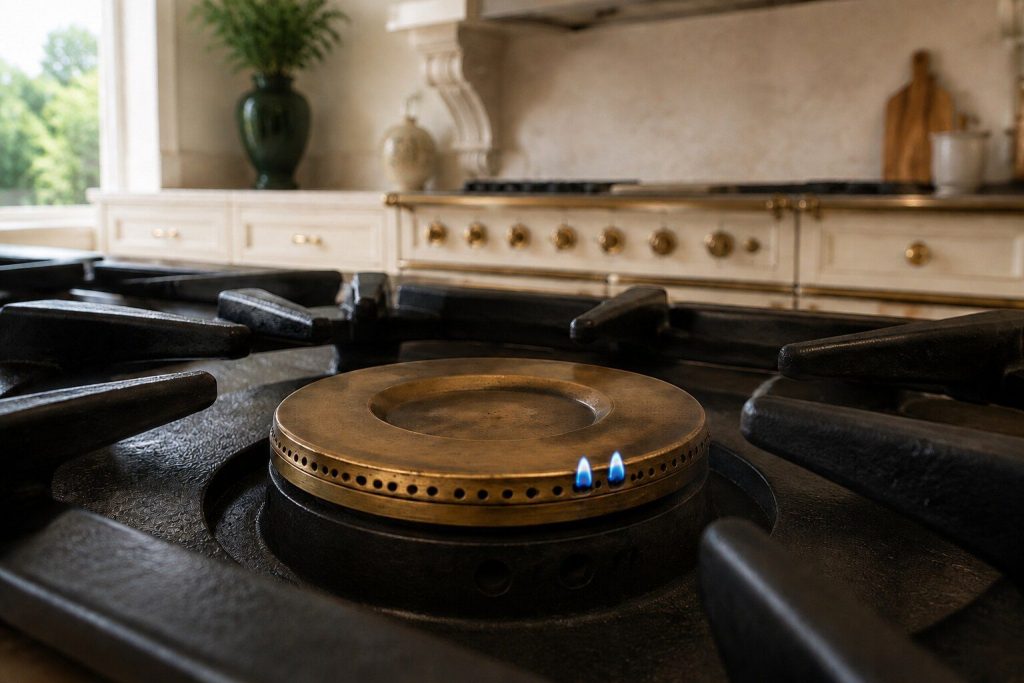
It lights and then goes out Burner will not stay lit
A burner that lights while the knob is held and dies when it is released is a flame supervision failure, and it is the same problem whether it happens on a surface burner or in the oven. The safety system is doing what it exists to do; the reason it no longer trusts the flame is what needs finding.
- The safety chain is working — it just no longer sees the flame
- Thermocouple, then valve, in that order
- An oven that does this is a same-day call
-
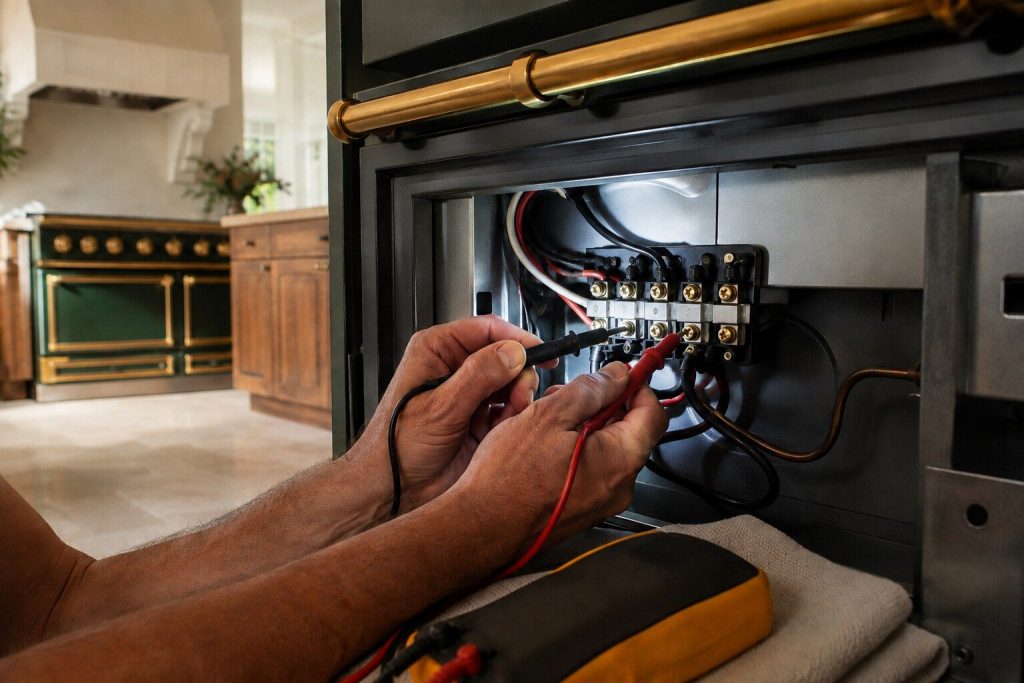
from $95 Diagnostic visit
One visit, one technician, one answer in writing. On a make with three error codes in its entire documentation, the diagnostic is not a formality before the repair — it is the repair's only source of information, and it is done with instruments rather than by elimination.
- Measured, not guessed — this make reports almost nothing on its own
- The configuration code read off the range, because it decides the parts
- Written findings and a from-price before anything is opened

Questions people ask about this
It smells for a second when I light a burner. Is that a leak?
Almost certainly not. Gas reaches the burner slightly before the spark ignites it, and for a second or two there is unlit gas in the room. What is not ordinary is a smell lasting several seconds — that is a burner lighting slowly, which is worth booking — or a smell once the flame is established, which is not.
The oven smells of gas while it preheats.
Take this one seriously. A vaulted gas oven is a sealed cavity behind a heavy insulated door with no window, so you cannot see whether the burner is lit. A smell during preheat can mean the burner went out and gas is still flowing, or that ignition is slow and failing. Turn the oven off, do not try again, and get it looked at — the safety valve is meant to prevent exactly this and a smell suggests it is not doing so reliably.
The gas company came and said the appliance is the problem.
Then that report is genuinely useful — bring it to the visit. A utility technician isolates the appliance and confirms the leak is downstream of their meter, which tells us it is in the connector, the manifold or a valve. That is our work, it is a same-day priority, and the range stays off at its valve until it is done.
Could it be something other than gas?
Yes, and two of them are common. A new or long-unused oven smells of hot dust and manufacturing residue on the first few heats, which is sharp but not gas. And an electrical smell — hot plastic, hot wiring — is a different emergency with a different response: switch the range off at the breaker rather than the gas valve, and do not use it. If you cannot tell which you are smelling, treat it as gas and ventilate.
Safety & Risks
More guides like this one
-
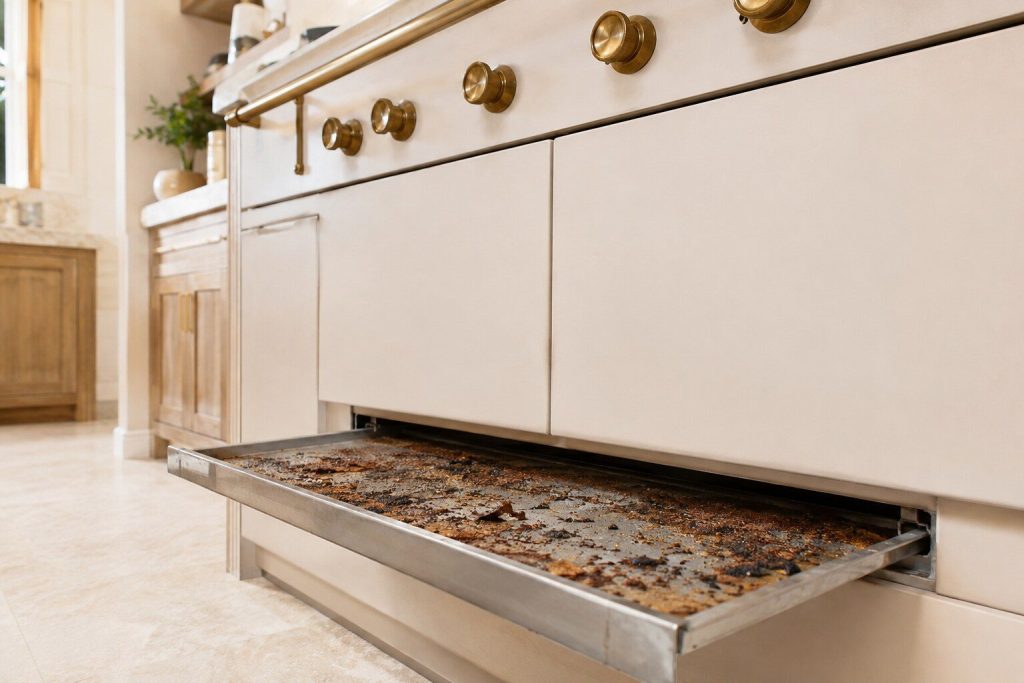
Why an Oven Smells of Burning, and Which Smells Matter
Seven ways people describe it, and each one means something different. Dust and residue are harmless. Hot plastic and hot wiring are not.
Read more -
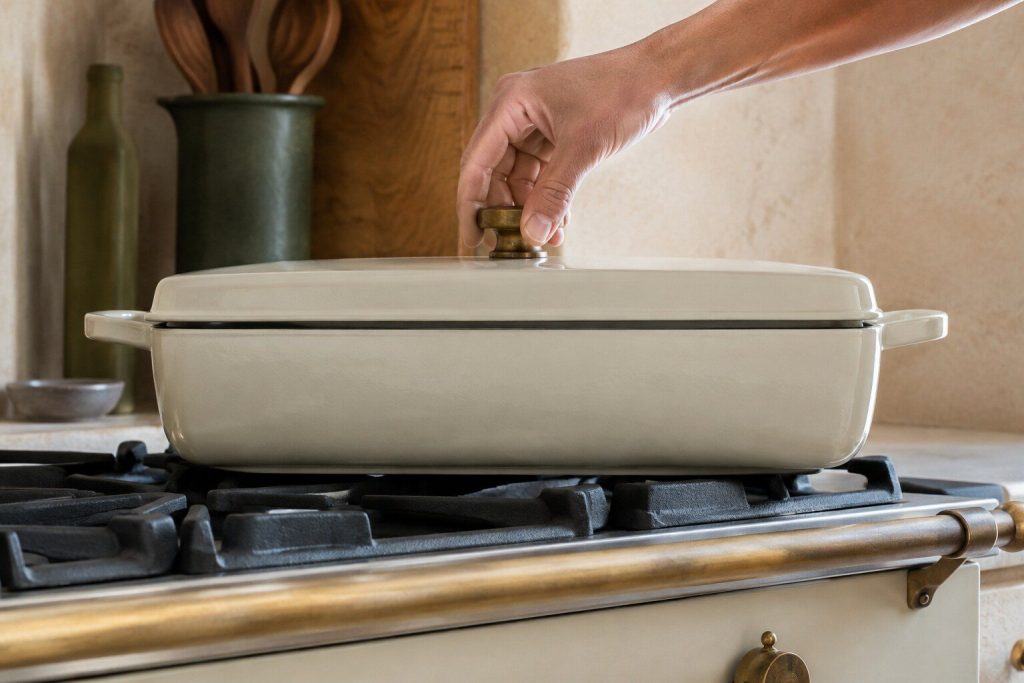
A Grease Fire on the Cooktop: Four Things, In Order
Never water. Cut the heat, cover the pan, leave it covered, and get out if it has left the pan. Written for a range with a 22,000 BTU burner and a lava-rock grill under a 600 CFM hood.
Read more
Tell us the model number and what it is doing.
This article is based on:
- Official manufacturer documentation
- Internal repair procedures
- Technician repair history
- Company quality standards