Diagnostic visit
from $95
Credited toward the repair. On a make with three codes in its entire documentation, this is where the information comes from — measurement rather than elimination.
Miami-Dade · Broward · Palm Beach
No two of these are quite the same appliance. A Château is assembled from choices somebody made at order time — which oven is gas and which is electric, whether the top carries a French top, a lava-rock grill, induction or a teppanyaki plate, which of about fifty enamels, which trim metal — and it arrives in a crate that can weigh 1,320 lb. That does not change what fails. It changes what a technician has to know before arriving, which is why we ask for the model code and the top configuration first.
What we repair
La Cornue builds cooking appliances and nothing else — no refrigeration, no laundry, no dishwasher, no microwave. What it does build is a range, the ovens inside it, the cooktop on top of it, the same top sold on its own as a rangetop, and the hood over it — and this site covers those five and stops. A repair company advertising La Cornue refrigeration would be telling you something untrue before it arrived.
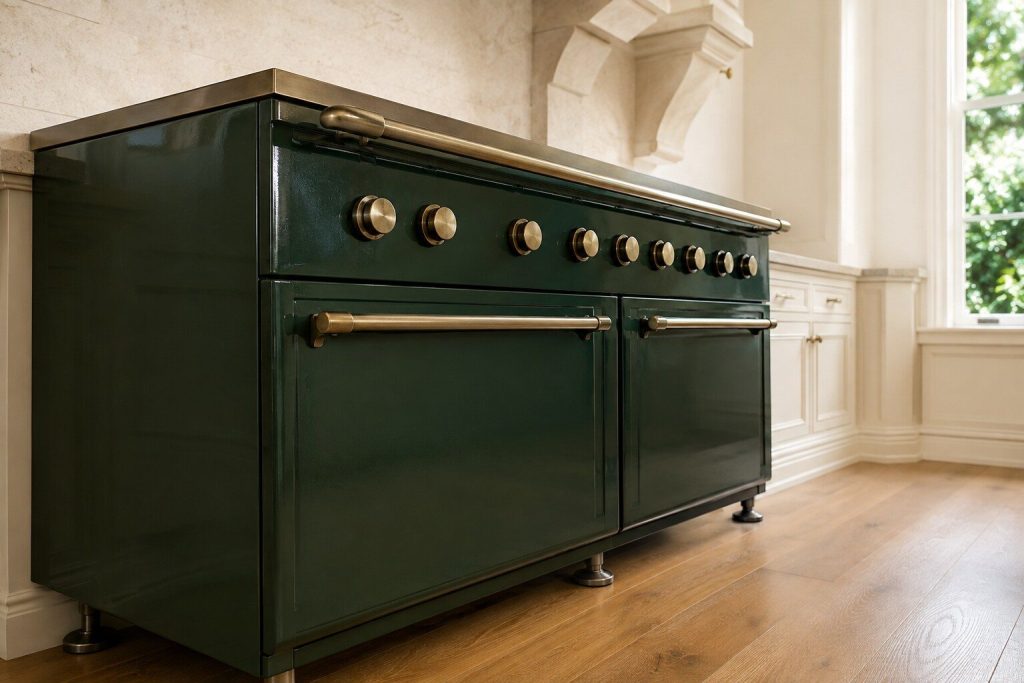
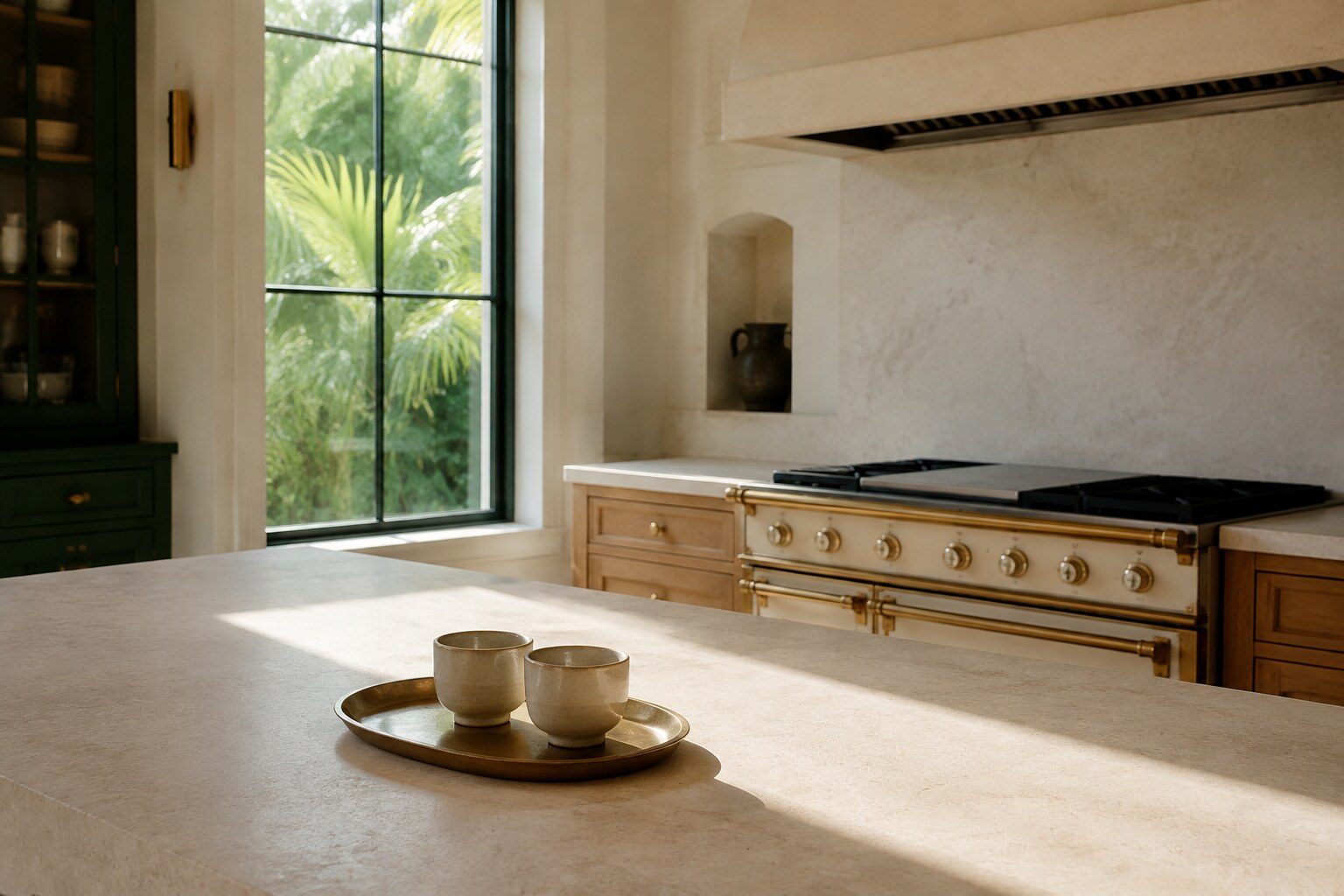
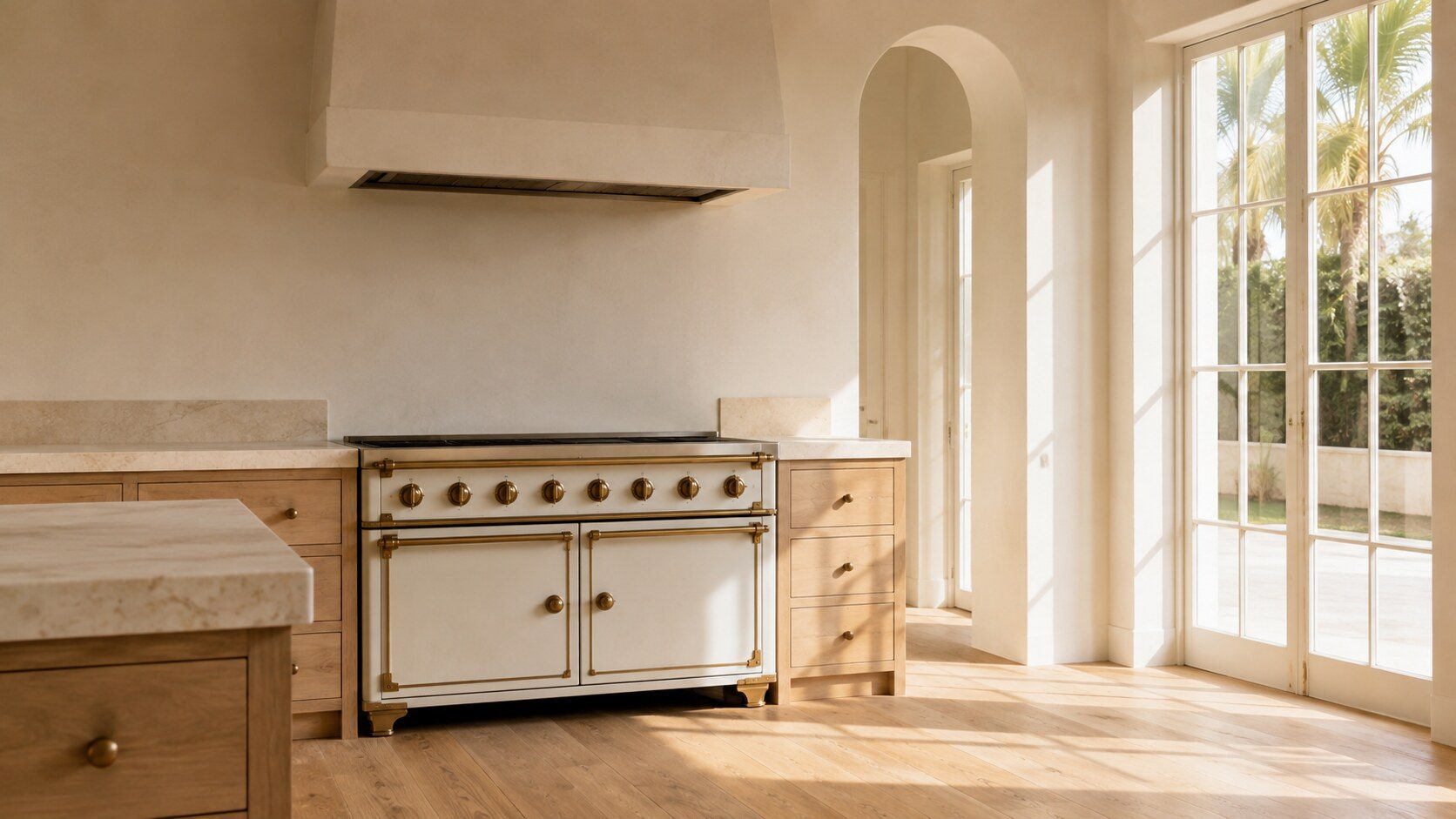
The range is what La Cornue makes, and everything else in the line exists around it. A Château is built to order in France, arrives in a crate weighing over half a ton, and is assembled from parts a customer chose one at a time: which oven is gas and which is electric, whether the top carries a French top, a lava-rock grill, induction or a teppanyaki plate, which of about fifty enamels, which trim metal. Two of them are almost never identical. That is the first thing a repair on one has to take seriously — the model number tells you the size, and the configuration code tells you what is actually under the lids.
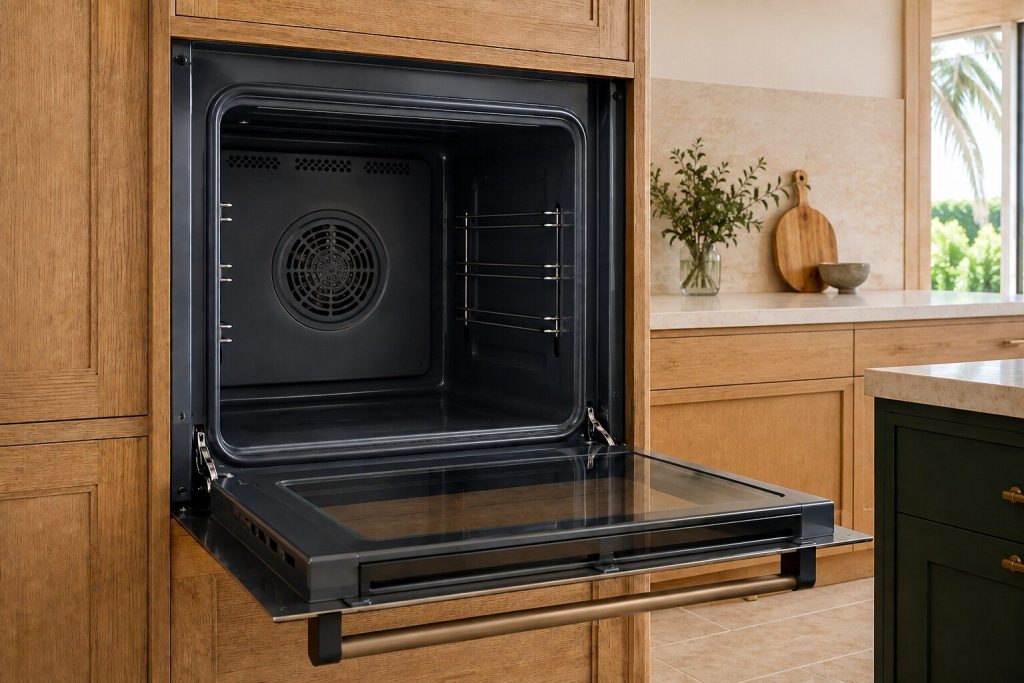
There are three different ovens on this make and they fail in three different ways. The vaulted gas oven cooks by radiant heat inside a sealed dome and has an electric broiler over it. The vaulted electric oven sits on the other side of the same range. And since 2025 there is a standalone one: the Château Tourelle, a fully electric multifunction wall oven in 60 and 75 centimeter widths, built to sit in a cabinet run next to a Château cooktop. Which of the three you have decides everything about the repair.
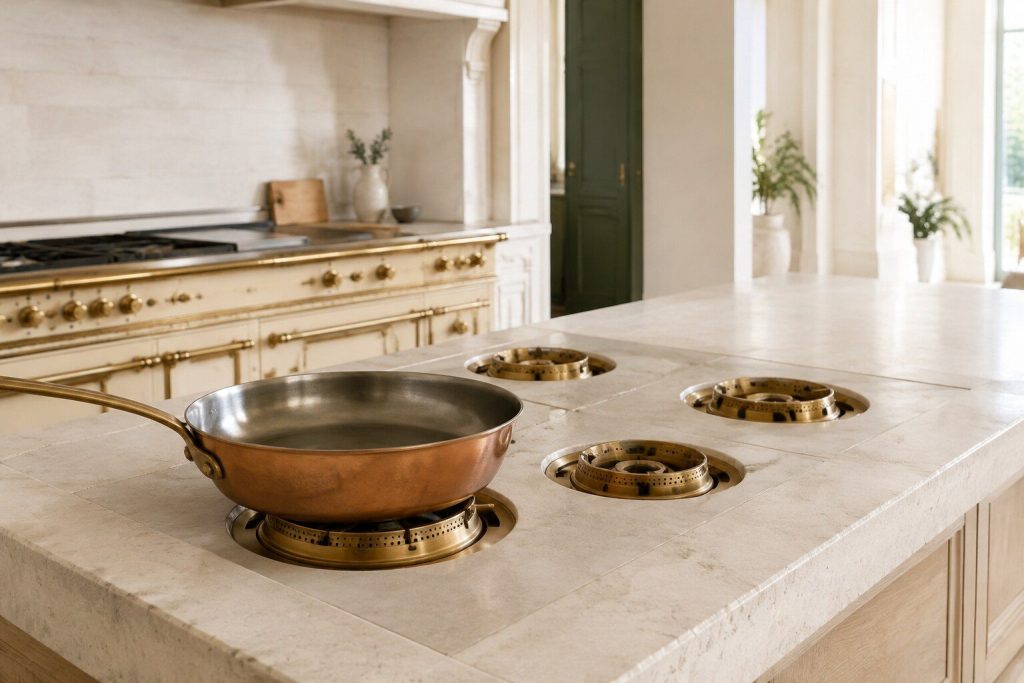
A La Cornue cooktop is a set of modules chosen at order time and dropped into a stainless frame: brass gas burners at 17,000 and 7,500 BTU, a 22,000 BTU power burner, the cast-iron plaque coup de feu heated by a single burner underneath, a lava-rock grill, ceramic-glass induction zones, an electric teppanyaki plate. This is the top of a range, and each module is a different repair. Sold on its own without ovens beneath it, the same top is a rangetop, and it has its own page.
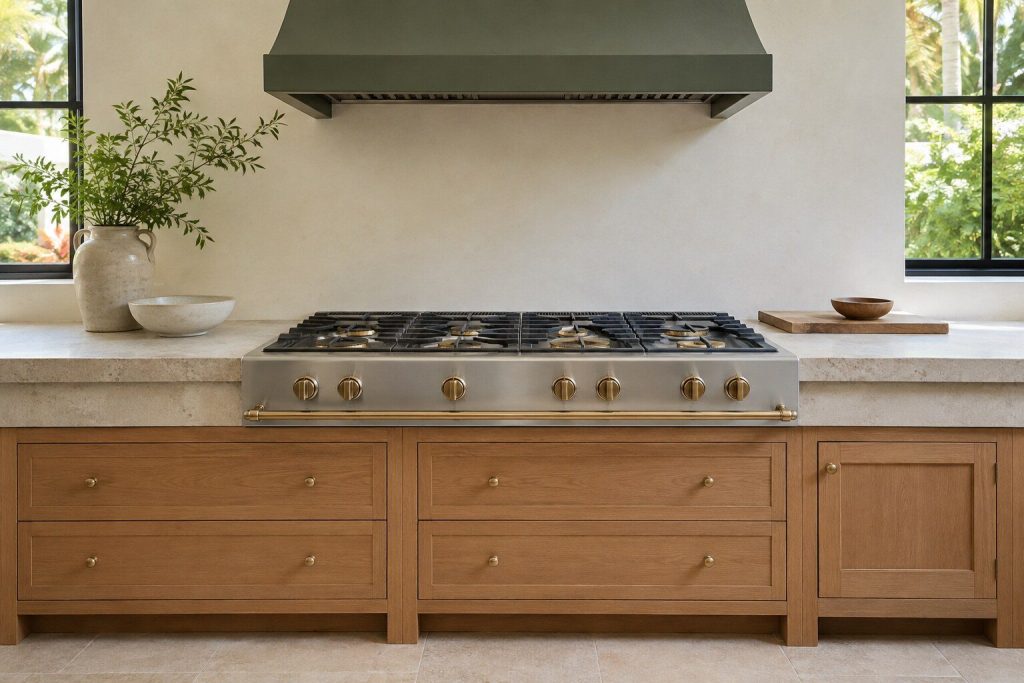
A rangetop is the top half of a La Cornue sold in its own right: the same brass burners, the same plaque coup de feu, the same grill, induction and teppanyaki modules, in a stainless frame 200 mm deep that drops into a counter with nothing underneath it. T40 through T48, from 600 to 1800 mm wide. Every cooktop repair applies to it and no oven repair does — which makes it the simplest appliance in the line and the one most often confused with the range on a booking.
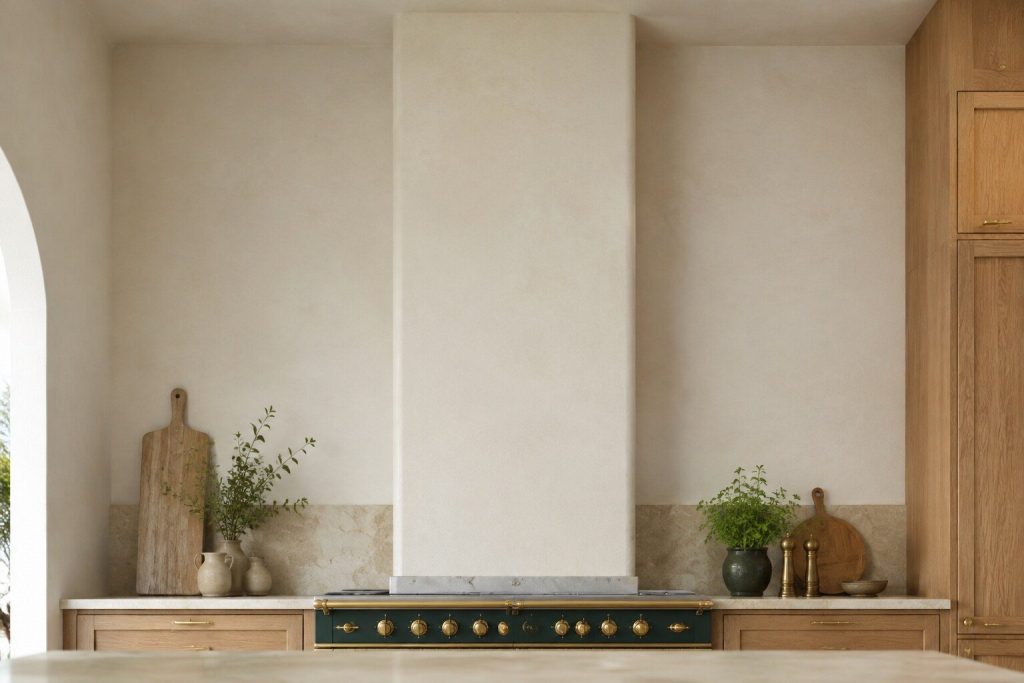
The hood over a La Cornue is not an accessory bought to match. A motorized Château hood starts at $17,400 for the 90 and runs past $25,000 for the Grand Palais 180, it is made in the same enamels and trims as the range, and it does real work: a 600 CFM blower on a four-speed variable motor, baffle filters with a grease capture system, three 20-watt lights and a remote. When one stops, the kitchen it was built for stops working properly.
South Florida
Read the model, because there is almost nothing else to read
La Cornue publishes exactly 3 error codes in the whole of its US documentation — E2, U400 and Er with a number — and all three are on the induction hob. The Château installation and user guide has no troubleshooting section at all, and neither does the Tourelle guide. So this site publishes those three and the 19 conditions the maker's own guides describe in words, every one quoted from a document archived before a page was written.
The model code, and the configuration code that came with the order
A make that documents three codes gets three code pages. A sibling network published about 38 invented ones for another brand — symptoms dressed up as codes — and that is the specific thing this site refuses to do. Where the maker says nothing, this site says that the maker says nothing.
What a La Cornue display can show, and which half of the line it belongs to
E2 · U400 · Er
The only three error codes, and only on the electronic models: induction cooktops and rangetops and the electric and multifunction ovens. E2 is the electronics too hot, U400 is a wrong electrical connection, Er with a number is an internal problem the user cannot clear.
H · A · L · L1 · L2 · P
Indicators, not errors. Residual heat above 140 °F, automatic heat-up, child lock, the low and simmer settings, power boost. An L switched on by a child accounts for a fair share of calls about dead cooktops.
The pan symbol
The pan detector reporting no pan, or a pan too small for that zone. The published minimums are 4¾ inches at the front left, 5½ at the rear zones and 8¼ in the center — a smaller base will not couple at all, and nothing is broken.
Nothing at all
Every gas Château, every gas rangetop and both vaulted gas ovens. There is no display, no code and no history, which is normal for this make rather than a sign the electronics are dead.
The things worth knowing before you look anything up
| E2 vs Er | E2 is a protection: the electronics got too hot and shut down, and the maker's first suggestion is ventilation. Er is the appliance saying the problem is inside it and cannot be cleared by the owner. One of them is often free to fix and the other is always a technician. |
|---|---|
| U400 | The cooker has been incorrectly connected, in the maker's own words. The control switches off after about a second and the code then stays on the display permanently, by design. It is one of very few messages here where the honest answer may be that nothing inside your range is broken. |
| H | Not a code. The zone is still above 140 °F and can burn. It clears itself as the glass cools, and an H on a zone nobody has used is the only version of it worth a call. |
| The oven lamp | The maker disagrees with itself. Its US Albertine guide says to ask for a 40 W 120 V halogen G9; its CornuFé 110 guide prints 230 V for the same lamp, which is a European figure. On a US range it is the 120 V lamp, and the guide states plainly that it is not a warranty part. |
| No code at all | On a gas Château this is the normal state of affairs. An oven that will not light is diagnosed with a clamp meter on the igniter circuit, a millivolt reading on the flame supervision and a functional test on the safety valve — not by reading a display that does not exist. |
Every entry on this site names the document it came from, and 20 of the 22 carry a verbatim quotation from it. A script checks every quotation against the PDFs; the first time it ran it caught three misquotations of our own.
Photograph the display if there is one, then photograph the plate. What helps most on this make is not the display at all: it is the model code and the top configuration code, because those decide which parts travel with us.
Every code, indicator and documented conditionNothing on the display, or an appliance that has none? The whole gas half of this line publishes no code table at all — the Château ranges, the gas rangetops and both vaulted gas ovens — so this site publishes none for them. Start from what the appliance is doing instead.
How a visit runs
On this make those are two halves of one question. A Château 150 in a K3 top and the same range in a K6 need different parts for the same complaint, and a technician who discovers that in your kitchen has discovered it too late. The original invoice or the dealer's order confirmation is more useful here than on any other make, because it carries the configuration and the finish reference.
Igniters, thermocouples, safety valves, elements, thermostats, seals, lamps and the common hardware travel with us. Where a part is a made-to-order item from Saint-Ouen-l'Aumône we say so before the visit rather than after. And the enamel gets covered and supported before anything is undone, because a hammered or bespoke finish cannot be touched up in a kitchen.
The free causes go first because they are free — a pan below the minimum diameter, an H on the display, a dish of water on the shelf to check the range is level, a strip of paper in the door seal, a burner head refitted wet. Then the measurement: gas pressure at the manifold, igniter current, shelf temperature against the dial. Nothing is opened until you have the figure, and the diagnostic comes off it.
Every joint that was opened is leak-tested, every burner relit, both ovens run up, and the range checked for level with water on a shelf if it moved at all. On a range this heavy that is the difference between a repair and a cooking complaint six months later.
What it costs
Every figure here is a starting point for this equipment in South Florida, researched rather than invented, with the reasoning written down. All 26 of them have a cost page with the evidence beside it.
from $95
Credited toward the repair. On a make with three codes in its entire documentation, this is where the information comes from — measurement rather than elimination.
from $165
The lowest figure on the site, deliberately. Two of the three problems on that page are things you can settle in a minute, and we would rather tell you than take the call.
from $175
Faded extraction with a healthy-sounding motor is almost never the motor. Baffles are dishwasher safe, so the first fix here is frequently free.
from $185
A probe on the shelf through a full cycle. Often adjustment rather than a part — and the before and after figures go in the report, because a corrected oven changes your cooking.
from $245
A job that exists on no other site in this fleet. The question the visit turns on is crack or crazing, and getting it wrong is expensive in both directions.
from $595
The highest figure here. Ordered against the top's own zone layout rather than a size, with the coils and electronics inspected for what came through the crack.
Every figure here is a starting point and a researched market band for South Florida, never a quote and never an invoice. The exact cost is confirmed after an on-site diagnostic and agreed in writing before anything is opened.
Every figure, and what moves itWhere we work
59 cities and neighborhoods, each with a page saying what we actually see there. Tell us where you are when you book and we will come back with the earliest slot we can genuinely keep.
Neighborhoods people ask for by name
Coverage is the whole of Miami-Dade, Broward and Palm Beach — the pages below are the places people search for by name, not the edge of where we drive.
Add the top configuration code if the paperwork survives, the finish name, and a photograph of anything the display is showing. Between them we can usually name a likely part before anybody sets off — and you get the scope and the price in writing before anything is opened.
This article is based on:
Before you call
Usually two, because on most of this line the two ovens are not the same appliance. A Château 120 and everything above it is dual-fuel by design: a vaulted gas oven with an electric broiler on one side, a vaulted electric oven on the other. They share a cabinet, a control panel and nothing else. So the first question on the phone is which door you opened. The exception is a range ordered with an all-induction top, where the maker's own order form forces both ovens to be electric.
There is no error message because a Château gas oven has nothing to print one with, and that is normal rather than a sign the electronics are dead — the maker's own guide for these ranges has no troubleshooting section at all. The diagnosis is a current measurement on the igniter, because the safety valve opens when the igniter draws enough amps and not when it looks bright. Two attempts and then stop: a sealed vaulted cavity is not somewhere to leave unburnt gas.
One of only three codes La Cornue documents anywhere. It means the electronic unit under the hob is too hot, and the maker's own first suggestion is not a part — it is to check the installation and whether there is sufficient ventilation, with a pan boiled dry as the second cause. So look in the cabinet under the cooktop before anybody quotes for a board. What we will not do is clear it and hand the range back, because repeated overheating is what eventually destroys the board the code is protecting.
Because La Cornue does not build one. It makes ranges, the vaulted ovens inside them, rangetops and hoods, and this site covers those 5 and stops. There are 47 model pages here, every code taken from the maker's own January 2026 price list and specification sheets — and nothing outside them.
Almost never, and that is by design rather than reluctance: these are built to be serviced from the front, where they stand, for decades. Most of the gas train, the valves, the igniters and the cooktop modules are reached without the range moving at all. A Grand Palais 180 is about 710 lb uncrated, so when something genuinely does require access from behind it is a planned job with enough people and the right equipment — and the range is re-leveled and proved afterwards.
No. We are an independent repair company working in Miami, not affiliated with, authorized by or endorsed by any manufacturer, and we warrant our own workmanship. What we have is 21 symptom pages and 22 code and condition pages, every one of the latter read out of a La Cornue installation or user guide and naming the document it came from.