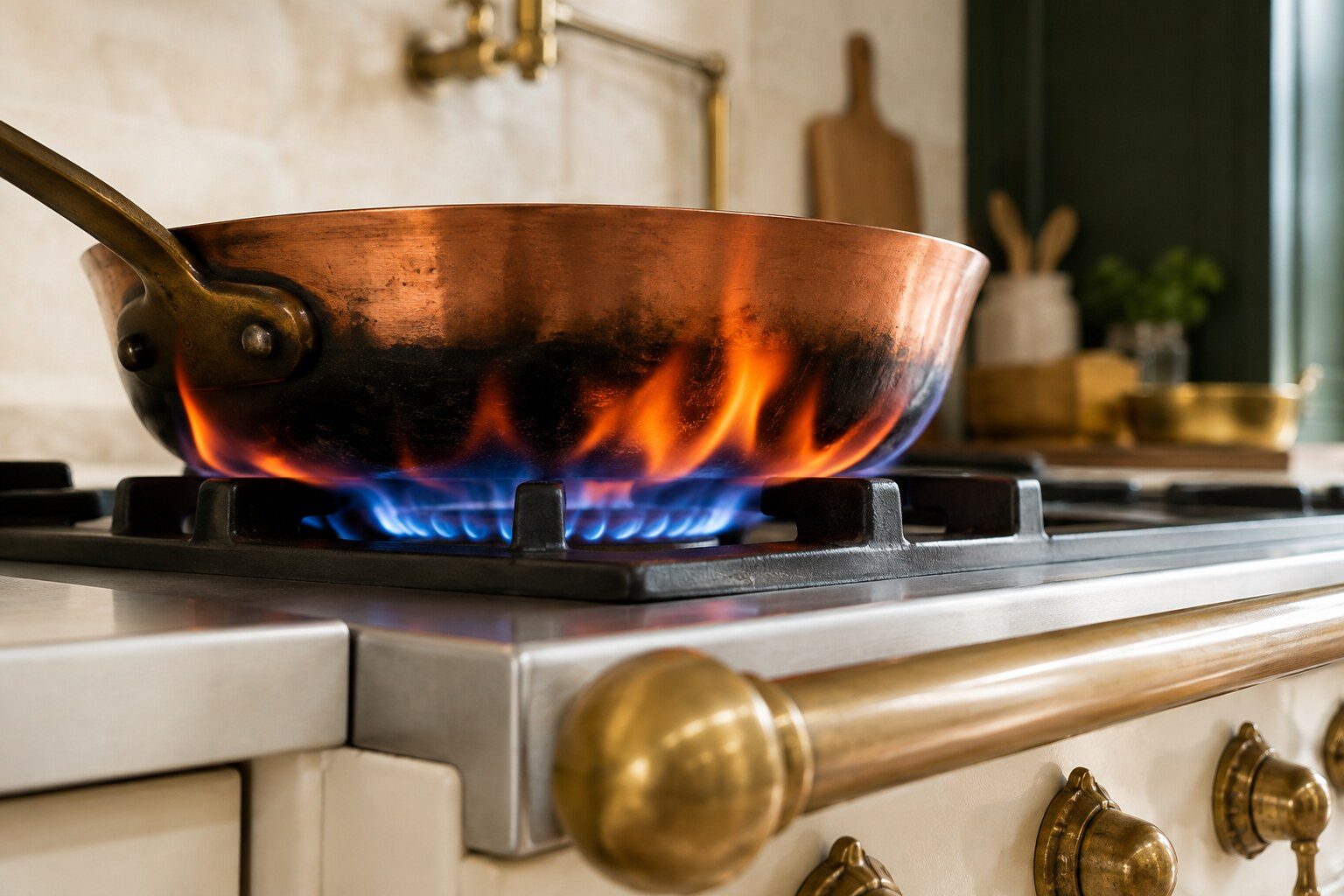
- “Blue is correct — yellow is an air, fuel or orifice problem”
- “A bad propane conversion is the leading cause on a relocated range”
- “Soot on a pan bottom is the symptom people notice first”
Symptom
La Cornue yellow or orange flame
A gas flame on this range should be blue with a defined inner cone. Yellow or orange tips, soot on the bottom of a pan and a smell of unburnt gas mean the air-to-gas mixture is wrong, and on a range that has moved house or changed fuel that has a specific and common cause.
- From $95 diagnostic, credited to the repair
- 59 cities and neighborhoods covered
- OEM parts available on order
- In writing the price, before anything is opened
Five ordinary causes
What this usually turns out to be
Cheapest and commonest first, which is also the order we check them in. They sit hundreds of dollars apart, and only the unit settles which one is yours.
-
A propane conversion done with the wrong parts
The commonest cause on a range that changed fuel or house. The maker publishes the correct orifice set.
Propane conversion service from $325 -
A partly closed or blocked air shutter
Local to one burner, and adjustable rather than replaceable.
Surface burner and igniter service from $155 -
A dirty or damaged orifice
A deformed port or a spider's nest in a summer-idle burner. Both real, both cheap.
Surface burner and igniter service from $155 -
A burner cap off its seat
Reassembled slightly wrong after cleaning, which changes the mixture immediately.
Surface burner and igniter service from $155 -
Supply pressure out of specification
Measured at the manifold. Where every burner is wrong and the parts are right, this is why.
Gas valve and thermocouple repair from $265
In five minutes
Before you call anybody
None of it needs tools, and all of it makes the visit shorter.
-
01
Look at the color properly
In a dim kitchen, not in daylight. Blue with a defined cone is right; yellow tips are not.
-
02
Check a pan bottom
Soot is the objective evidence, and it is what tells the difference between a warm color and a real problem.
-
03
Count the burners affected
One is local. All of them is fuel, pressure or a conversion.
-
04
Find the conversion paperwork
If the range has ever changed fuel. Its absence is useful information too.
How it shows up
What people describe when they call
A shortcut
Narrow it down before anybody arrives
A description of the behaviour leaves a few possible causes. A code names the subsystem before anybody opens anything, which is why it is worth photographing before it clears.
If there is no code at all
On a range, the data plate is behind the kick panel or on the frame under the oven door. On a rangetop, the data plate is under the deck or behind the kick panel. On a cooktop, the data plate is under the front edge. All models
In more detail
About La Cornue yellow or orange flame
The one thing to look at before calling
One burner or all of them. A single yellow burner is usually a blocked or partly closed air shutter, a dirty orifice or a burner cap sitting slightly off its seat — small, local and cheap. Every burner yellow at once means the fuel or the supply pressure is wrong for the way the range is set, and that is where a propane conversion, a moved range or a new regulator comes into it. Also worth knowing: a brand-new orange flicker for the first minute after lighting on a range that has been idle for weeks is dust burning off and is not this.
What it usually means, by the kind of La Cornue appliance
La Cornue sells one appliance in several forms, and the same behavior points at different things on each of them. A built-in side-by-side and an integrated column are not the same service situation, and a dual-fuel range and an induction range fail in different halves.
- Château gas and dual-fuel — Orifices and air shutters are set for the fuel specified at order time, and altitude above 2,000 feet is specified too.
- CornuFé 90 and 110 dual fuel — La Cornue publishes a conversion procedure and a parts set for these two models specifically. A conversion done without them looks exactly like this.
- All-induction — No flame at all. Nothing on this page applies.
Why this matters beyond the cooking
A yellow flame is incomplete combustion, and incomplete combustion produces carbon monoxide as well as soot. On a range with six or eight burners and a gas oven, in a kitchen with the windows shut and the air conditioning on, that is not a cosmetic complaint. It is also the fastest way to ruin cookware and the enamel around a burner. We treat a whole-range yellow flame as a priority call rather than a maintenance one.
Propane, altitude and the paperwork
La Cornue specifies fuel type at order time and asks about installation above 2,000 feet, and it publishes a conversion procedure with a defined parts set for the CornuFé 90 and 110. What we see is ranges converted with universal kits, ranges converted in part — the fronts done and the plaque burner forgotten — and ranges moved from a propane house to a natural-gas one with nothing changed at all. All three produce this page. Fixing it properly means the maker's own orifices, every burner set, a leak check, and a written note of what the range is now on.
This article is based on:
- Official manufacturer documentation
- Internal repair procedures
- Technician repair history
- Company quality standards
Before you book
Questions about La Cornue yellow or orange flame
The flame has always looked slightly orange. Is that just how it is?
No. There is one exception — a soft orange flicker for the first minute on a range that has been unused for weeks, which is dust burning off — and beyond that, a La Cornue burner is a blue flame. If it has looked orange since the day it was installed, that points at the installation: fuel type, orifices or supply pressure never set correctly. It is worth a diagnostic, and on a range this age the fix is usually adjustment rather than parts.
Could this be why my food tastes odd?
It can be, and it is a complaint we take seriously rather than smile at. Unburnt gas has a smell, soot has a taste, and both end up on food cooked over a rich flame — particularly anything grilled directly or cooked on the plaque. A correctly set burner is odorless. If the taste appeared at the same time as the color, they are the same problem.
Where we do it
Across Miami-Dade, Broward, and Palm Beach
Same terms everywhere we go: an on-site diagnostic first, the price agreed in writing, and the exact figure confirmed once we have seen the unit.
Neighborhoods people ask for by name