Common Problems
What a French Top Is For, and How to Cook on One
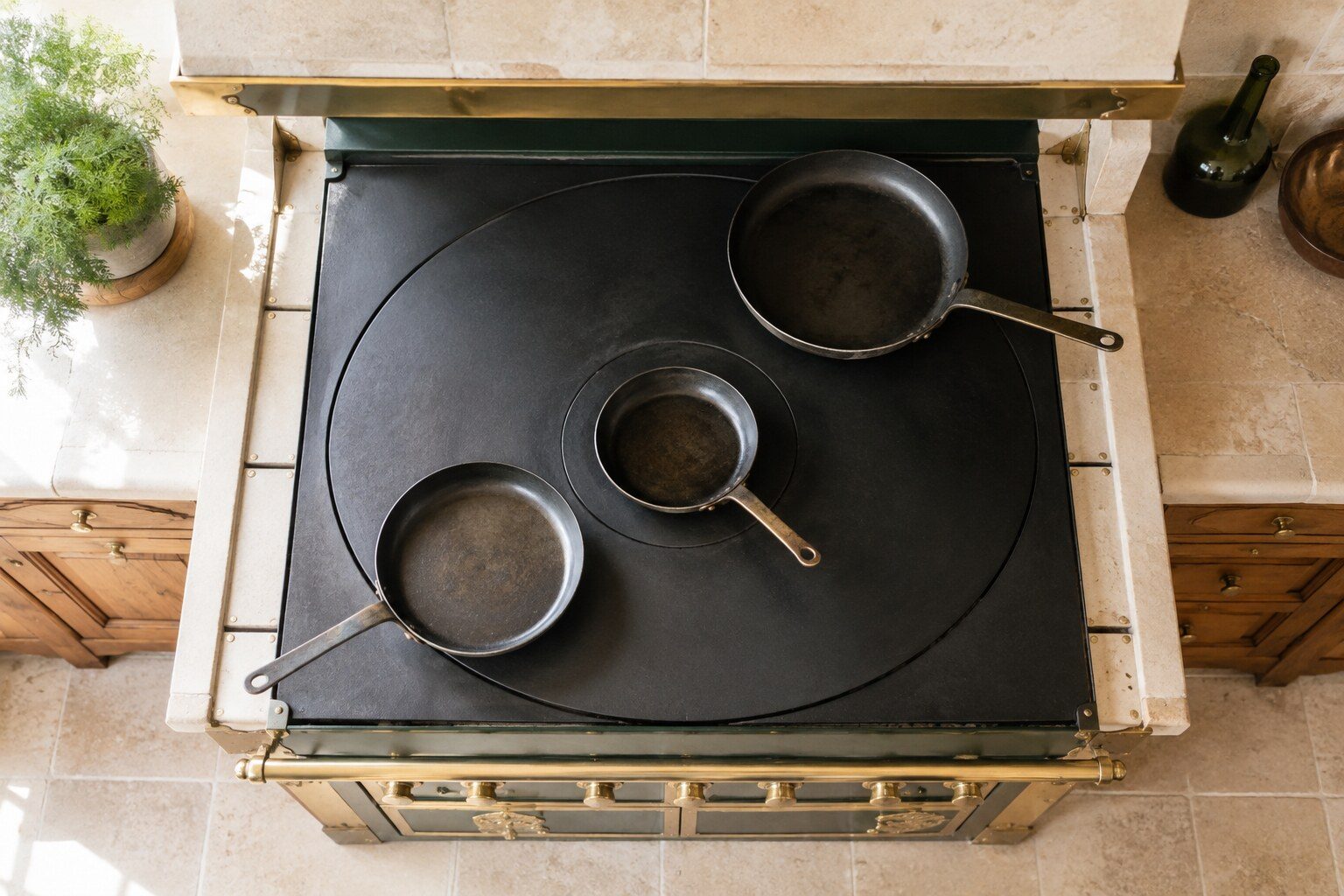
The plaque coup de feu is a single cast-iron plate heated by one 7,500 BTU gas burner directly beneath its center. The whole plate becomes the cooking surface, hottest directly above the burner and progressively cooler towards the edges, so you control heat by where you put the pan rather than by adjusting a flame. Sear at the center, hold a sauce at the mid zone, keep something warm at the corner — all at once, from one burner. It takes twenty minutes to come up because it is thermal mass rather than a flame, and it needs to be kept dry and seasoned like any cast iron. Never put anything wet on it while it is hot: thermal shock is the main cause of a cracked plaque, and a replacement plate is a made-to-order part ordered against the range's own configuration.
The full guide
La Cornue oven french top: the thing that makes this range what it is
Every brand has a signature. La Cornue's is a slab of cast iron with stars engraved on it, and most owners never use it properly.
The *plaque coup de feu* — the French top — is a single cast-iron plate with one gas burner underneath its center, rated at 7,500 BTU on natural gas. That is less heat than the small rear burner on the same range. The plate is not there to receive a lot of heat; it is there to spread a modest amount of it across a whole surface and hold it.
Which means it is not a burner, and it is not a griddle. It is a heat *reservoir with a gradient*, and once you cook on it that way it does something nothing else on the range can.
How you actually cook on one
You stop using the knob.
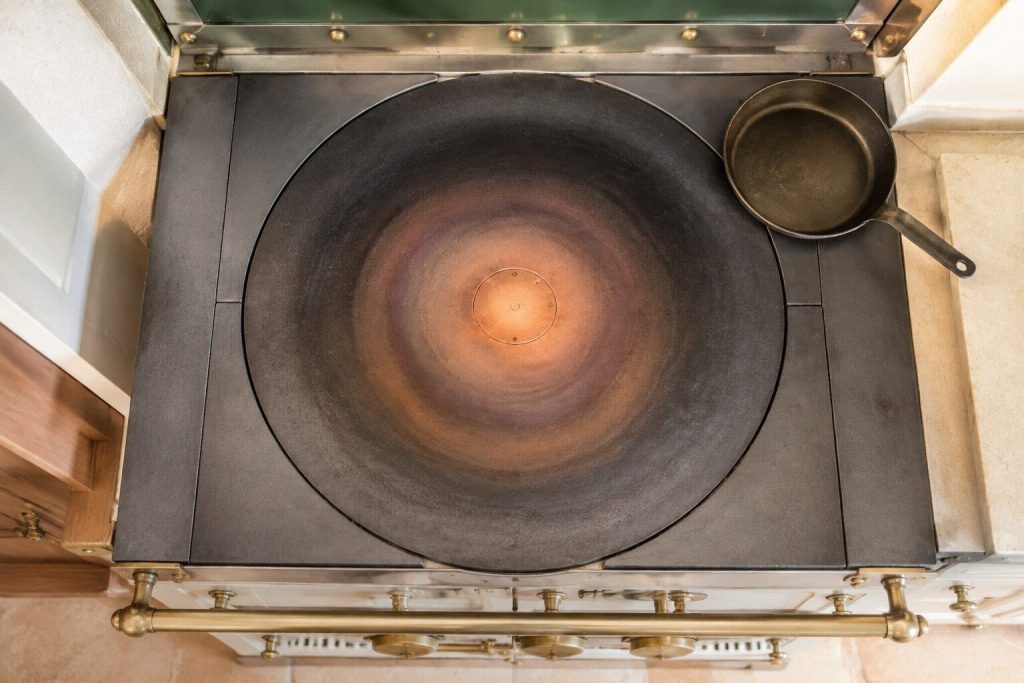
The center, directly above the burner, is the hot zone: searing, reducing hard, getting a pan up fast. Move a few inches out and you have a working boil. Further out, a simmer that will not catch. At the corners, warm — the place for a pan of something you want to hold for twenty minutes without touching it.
All of those exist at the same time, from one burner. So a sauce goes to the edge while a steak sears at the center, and neither needs adjusting. Move the pan, not the flame. That is the whole technique, and it is why professional French kitchens built around these for a century.
There is a second consequence: the plate cares nothing about pan size or shape. A wide pan, a copper *rondeau*, a small saucepan and a stock pot all sit on it happily, and nothing is balancing on a trivet over a ring that is too small for it.
It takes twenty minutes, and that is not a problem
Judged five minutes after lighting, a plaque looks broken. It is a considerable mass of iron being warmed by one modest burner, and it needs about twenty minutes to develop its gradient — longer if you want the center searing hot.
So a French top is not the thing you light when you get home and want to cook immediately. It is the thing you light first and then work on for two hours, which is exactly how a Sunday in a kitchen with one of these tends to go.
Keeping it
Cast iron, kept dry and seasoned, will outlast the kitchen it is in. Left wet, it rusts, and rust is what eventually turns a normal thermal cycle into a crack.
Clean it warm, not hot, and dry. A scraper and a dry cloth while there is still some heat in it. If something has burnt on, let it cool and work at it dry.
Never put anything wet on a hot plate. No damp cloths, no cold liquids, and absolutely no washing it down while it is up to temperature. Thermal shock is the leading cause of a cracked plaque and it is entirely avoidable.
Season it like a pan. A thin film of oil on a warm plate, wiped almost dry. It is what keeps it from rusting and what makes cooking directly on it pleasant.
Look underneath occasionally. The face nobody inspects is the one that rusts first in this climate, and scale on the underside insulates the iron from its own burner. That is one of the commonest causes of a plate that has quietly lost its performance.
Crazing is not a crack
Worth knowing before you panic, because the two look alike and they are not.
Crazing is a fine spider web in the black seasoning layer. It does not catch a fingernail, it is the normal appearance of a well-used plate, and it means nothing at all.
A crack is a single line, usually running from an edge or from the hot center outwards. It catches a nail, and it often shows a rust line along it because moisture has got into the casting. Let the plate go cold, clean it back dry, and look with daylight on it.
If it is through the iron, stop using it — a cracked plate can move, and a moving plate over a lit burner is not worth the risk. A replacement is a made-to-order part ordered against the range's own size and configuration, so it comes with a lead time rather than off a shelf.
When it is genuinely the plate, and when it is not
In the order we actually find them:
The burner beneath it. By a wide margin. A yellow, small or partly blocked flame cannot load a plate this heavy, and the complaint arrives as "the plaque has gone cold in the middle".
The underside. Rust and scale.
The air path. Combustion needs air under the plate, and years of grease close it off gradually.
The seating. A plate that rocks is transferring heat across an air gap instead of through metal.
The iron itself. Last, and least often.
Which is why the first thing a technician does on a French top call is light the burner and look at the flame, not at the plate.
And the stars
The engraved *étoiles* on the plate are La Cornue's mark, and they are not decoration on the cooking surface for its own sake: they sit where the plate is hottest. Once you know that, they are a map — and a plate whose stars are no longer the hottest part of it is telling you something about the burner underneath.
If it turns out to be a repair
What this leads to, and what it costs
Every job on this site is priced the same way: an on-site diagnostic first, the figure agreed in writing before anybody starts.
-
The plaque has cold areas French top heats unevenly
The plaque coup de feu is meant to be uneven — hottest directly above its single burner and cooler as you work outwards, which is the whole point of cooking on one. What is not meant to happen is a cold center, a dead quarter, or a plate that no longer reaches the temperature it used to.
- Graded heat is the design — a cold center is not
- Most plate complaints start with the burner underneath
- Rust and scale on the underside change conduction
-
from $245 French top service
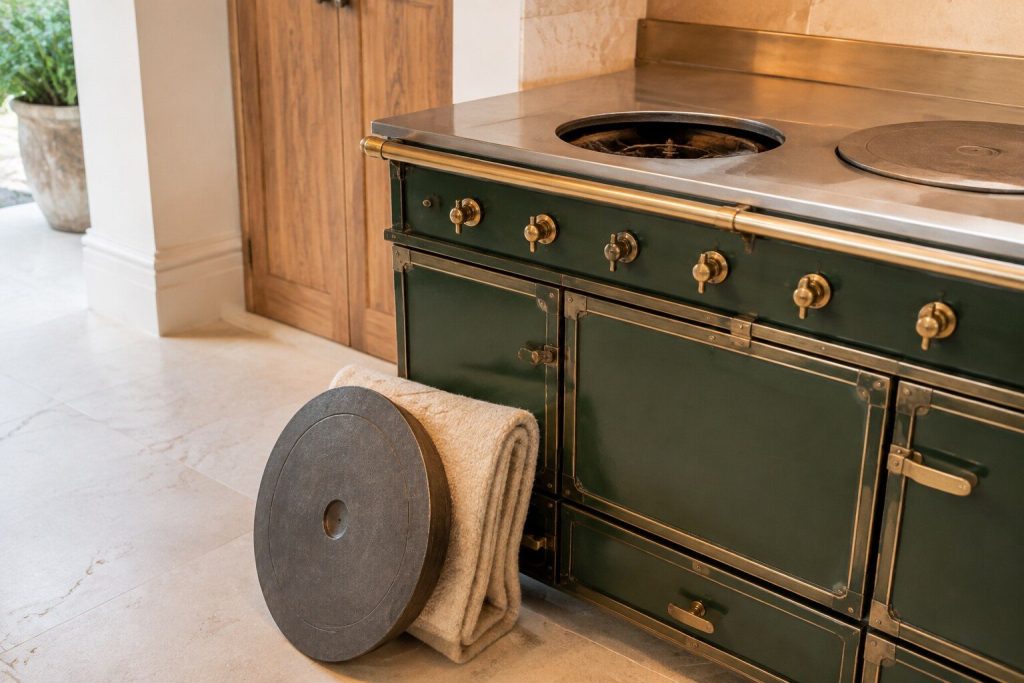
The plaque coup de feu is a single cast-iron plate heated by one 7,500 BTU burner directly under its center, and it is the most-used and least-understood part of the range. Cracks, warping, rust, dead cold spots and a burner running wrong underneath are all different problems that present the same way.
- Crazing in the seasoning and a crack through the iron are told apart
- The burner beneath it checked first — most cold spots start there
- Re-seasoned properly, so the plate is handed back working
-
Brass gas burners · plaque coup de feu · lava-rock grill · induction · teppanyaki Cooktops and rangetops
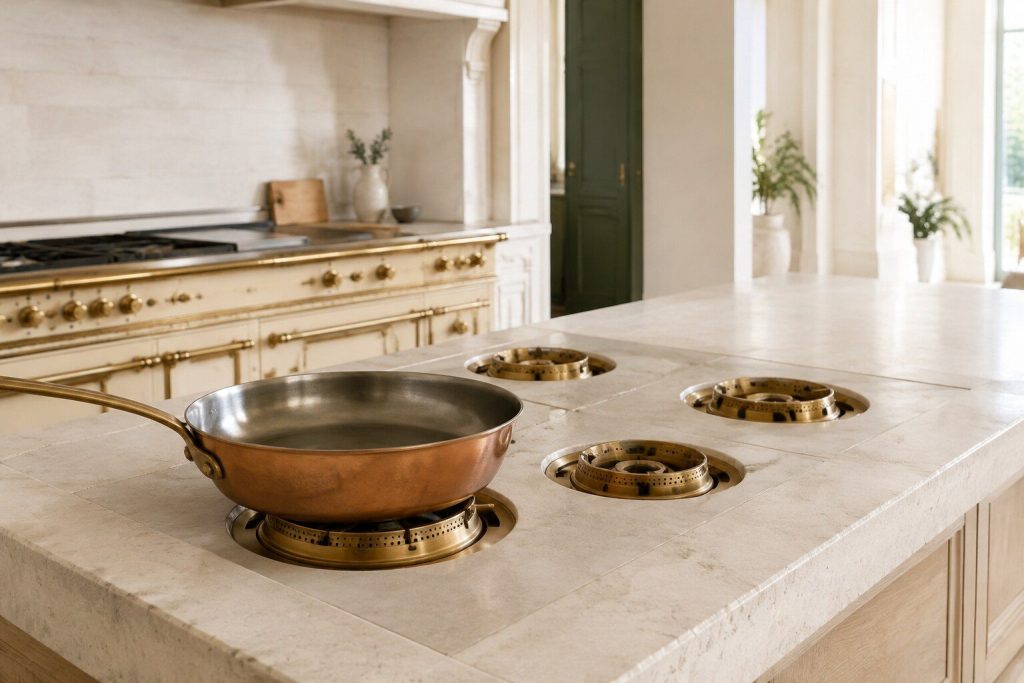
A La Cornue cooktop is a set of modules chosen at order time and dropped into a stainless frame: brass gas burners at 17,000 and 7,500 BTU, a 22,000 BTU power burner, the cast-iron plaque coup de feu heated by a single burner underneath, a lava-rock grill, ceramic-glass induction zones, an electric teppanyaki plate. This is the top of a range, and each module is a different repair. Sold on its own without ovens beneath it, the same top is a rangetop, and it has its own page.
- Gas, induction, French top, grill and teppanyaki modules on one frame
- Induction is the only half of this line that shows a code — E2, U400, Er
- A cracked glass hob is disconnected first and diagnosed second
Questions people ask about this
How hot does the center get?
Hot enough to sear directly on the iron after a proper preheat, with a usable simmer at the outer edge. We measure it rather than quote one figure, because it depends on the plate size, the fuel and how long it has been up. What matters diagnostically is the gradient and the ceiling: a plate whose center now tops out where its mid-zone used to be has lost its burner rather than its iron.
Can I cook directly on it?
Yes, and that is part of the point — a well-seasoned plaque takes a steak or a piece of fish straight onto the iron. Keep it seasoned, keep it dry, and clean it while it is warm rather than hot with a scraper and a dry cloth rather than water.
Mine has cold patches. Is the plate finished?
Probably not. Most cold-spot complaints start with the burner underneath — a weak or rich flame cannot load a plate this heavy — or with rust and scale on the underside, which insulates the iron from its own burner. A crack through the casting is the least common of the causes and the only one that is not adjustable.
Is a French top the same as a griddle?
No. A griddle is a flat surface you cook food on. A plaque is a heat distributor you cook pans on, with graded zones across it, and cooking directly on it is a bonus rather than the purpose. The teppanyaki module on this make is the griddle; they are different things at different temperatures.
Common Problems
More guides like this one
-
What Is Actually Different About a La Cornue Range
Hand-built to order since 1908, a vaulted radiant oven, a cast-iron plate heated by one burner, and a crate weighing up to 1,320 lb. Written by people who take them apart.
Read more -
Every Symbol on a La Cornue Oven Dial, and What It Actually Does
A La Cornue dial is iconography rather than words. Here is what each mark selects, why the gas side has fewer of them, and which symbols are not functions at all.
Read more -
How to Turn On a La Cornue Oven, Gas Side and Electric Side
It is a real question, not a beginner's one: the two ovens on a dual-fuel range are lit differently, and a multifunction oven with no mode selected does nothing at all.
Read more
Tell us the model number and what it is doing.
This article is based on:
- Official manufacturer documentation
- Internal repair procedures
- Technician repair history
- Company quality standards