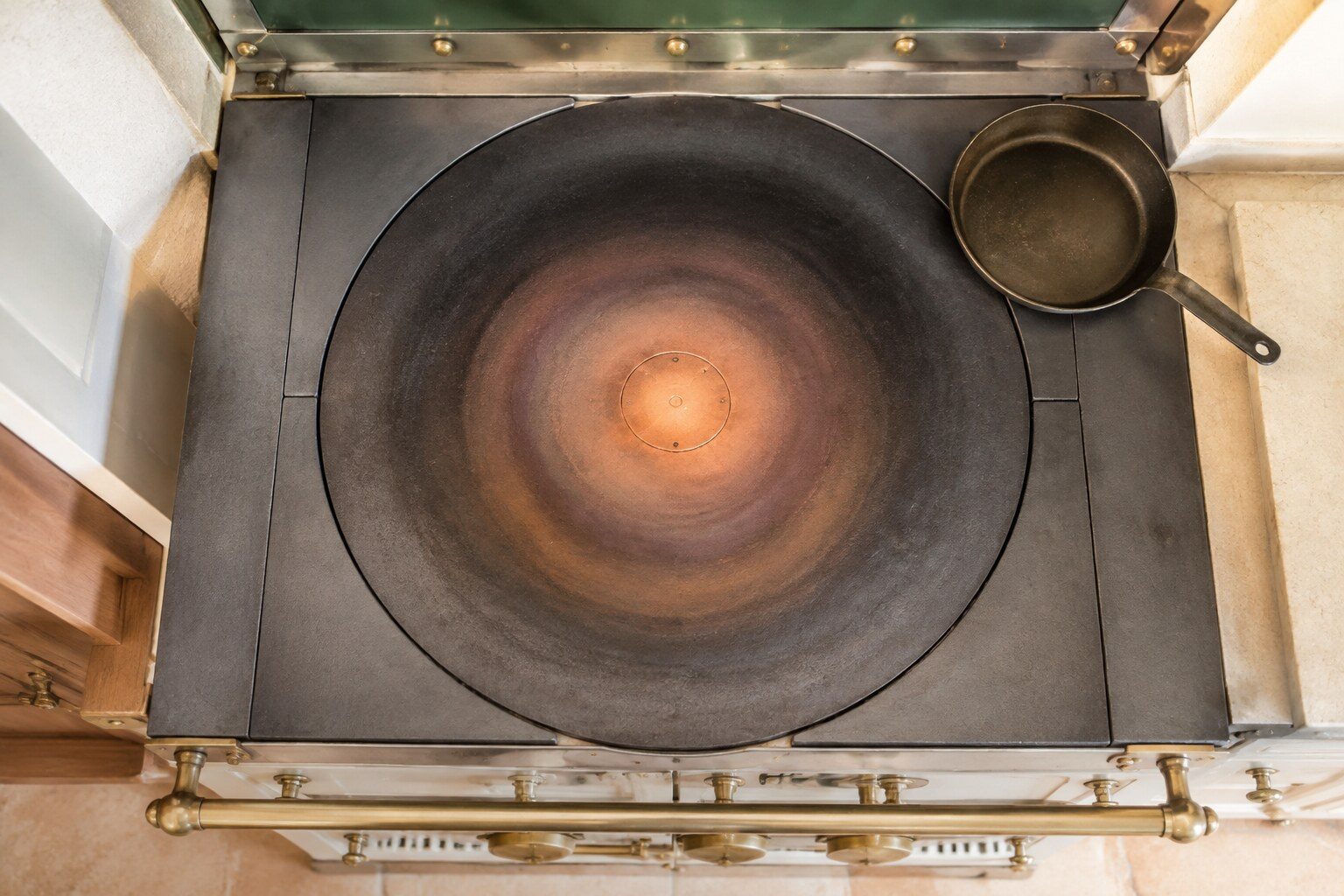
- “Graded heat is the design — a cold center is not”
- “Most plate complaints start with the burner underneath”
- “Rust and scale on the underside change conduction”
Symptom
La Cornue french top heats unevenly
The plaque coup de feu is meant to be uneven — hottest directly above its single burner and cooler as you work outwards, which is the whole point of cooking on one. What is not meant to happen is a cold center, a dead quarter, or a plate that no longer reaches the temperature it used to.
- From $95 diagnostic, credited to the repair
- 59 cities and neighborhoods covered
- OEM parts available on order
- In writing the price, before anything is opened
Five ordinary causes
What this usually turns out to be
Cheapest and commonest first, which is also the order we check them in. They sit hundreds of dollars apart, and only the unit settles which one is yours.
-
A weak or rich burner underneath
The most common finding by a wide margin. A yellow or small flame cannot load a plate this heavy.
Surface burner and igniter service from $155 -
Scale or rust on the underside
The face nobody inspects. It insulates the iron from its own burner.
French top service from $245 -
A blocked drip or air path
Combustion needs air under the plate, and grease closes it off gradually.
French top service from $245 -
A warped plate
It no longer sits down onto its seat, so heat crosses an air gap instead of metal.
French top service from $245 -
A crack through the iron
It interrupts conduction across the plate and it is the one finding that is not adjustable.
French top service from $245
In five minutes
Before you call anybody
None of it needs tools, and all of it makes the visit shorter.
-
01
Give it twenty minutes
A plaque judged after five minutes is a plaque judged wrong. It is thermal mass and it works slowly on purpose.
-
02
Map it deliberately
Center, mid, edge. Write the numbers down and the answer usually appears on its own.
-
03
Look at the flame underneath
Blue, even, and the right size. This is where most of these calls are solved.
-
04
Check that it sits flat
A plate rocking on its seat is transferring heat across air.
How it shows up
What people describe when they call
A shortcut
Narrow it down before anybody arrives
A description of the behaviour leaves a few possible causes. A code names the subsystem before anybody opens anything, which is why it is worth photographing before it clears.
In more detail
About La Cornue french top heats unevenly
Learn the plate before condemning it
Bring the plaque up for twenty minutes and map it with a pan of water or an infrared thermometer: center hottest, edges usable, corners warm. That is correct. If the center is not the hottest point, the burner underneath is the suspect, not the iron. If the whole plate is down evenly, it is the burner again. If one region is dead while the rest behaves, that is when the plate itself is in question.
What it usually means, by the kind of La Cornue appliance
La Cornue sells one appliance in several forms, and the same behavior points at different things on each of them. A built-in side-by-side and an integrated column are not the same service situation, and a dual-fuel range and an induction range fail in different halves.
- Château with a large plaque — One 7,500 BTU burner under a large plate. The whole surface depends on that single burner, which is why it is checked first.
- Château with a petite plaque — Same principle, smaller plate, and it comes up to temperature noticeably faster — so a slow petite plaque is a clearer signal.
- CornuFé — The factory-built models do not carry a plaque. If this is a CornuFé, we are talking about a solid element or a gas burner instead.
The mistake almost everyone makes with a French top
Treating it like a burner. A plaque is a single cast-iron heat reservoir, and it is used by moving pans around it rather than by turning a knob — full heat at the center for searing, a gentle simmer at the edge, and everything in between at once. That means the first question on this call is not what is wrong but what the owner expects, and a proportion of these visits end with a demonstration rather than a repair. We would rather do that than sell somebody a part for a plate that is behaving exactly as La Cornue designed it in 1908.
What actually goes wrong
In order of how often we find it: the burner beneath, the underside of the plate, the air path, the seating, and only then the iron itself. Every one of the first four is recoverable and three of them cost parts of nothing. It is also worth saying what a plaque does not suffer from — there is no element, no sensor, no board and nothing to calibrate. When it is working it will outlive the kitchen it is in.
This article is based on:
- Official manufacturer documentation
- Internal repair procedures
- Technician repair history
- Company quality standards
Before you book
Questions about La Cornue french top heats unevenly
How hot should the center actually get?
Hot enough to sear directly on the iron, which in practice means well over 500 °F at the center after a proper preheat, with a usable simmer at the outer edge. We measure it rather than quote a single number, because the honest figure depends on the plate size, the fuel and how long it has been up. What matters diagnostically is the gradient and the ceiling: a plate whose center tops out where its mid-zone used to be has lost its burner, not its iron.
Should I be seasoning it, and does that affect the heat?
Yes, and yes indirectly. Seasoning is what keeps a plaque from rusting and what makes it pleasant to cook on directly; it does not measurably insulate. What does insulate is the opposite — rust and baked-on carbon layers, particularly on the underside where nobody looks. Part of a French top service is cleaning that face back and re-seasoning the top properly, and we will show you how to keep it rather than leaving you to guess.
Where we do it
Across Miami-Dade, Broward, and Palm Beach
Same terms everywhere we go: an on-site diagnostic first, the price agreed in writing, and the exact figure confirmed once we have seen the unit.
Neighborhoods people ask for by name