The Château installation and user guide has no troubleshooting section. Neither does the Château Tourelle guide. The only place a code is printed anywhere in La Cornue’s US documentation is the CornuFé induction guide, and it prints three: E2, U400 and Er with a number. A sibling network once published about 38 invented codes for another brand — symptoms dressed up as codes — and that is the specific thing this archive refuses to do. Where the maker says nothing, this site says that the maker says nothing.
3 codes · 19 documented conditions
La Cornue oven symbols, hob indicators and the only three error codes this make has.
This is the shortest code archive on our fleet and the honest length for this make. La Cornue publishes three error codes in the whole of its US documentation — E2, U400 and Er with a number — and all three are on the induction hob. What its guides do document is nineteen conditions described in words, and those are here too, each one quoted from the guide it came from.
- 3 error codes in the entire make
- 19 conditions the maker documents in words
- 20 pages carrying a verbatim quotation
- 0 codes invented to fill the gap
The whole archive
Every code, indicator and documented condition
Three of these are error codes and nineteen are conditions the maker's own guides describe in words. Filter by appliance first: the codes belong to the induction and all-electric models and cannot appear on a gas range at all.
- E2 the hob electronics are too hot and have shut down
- U400 the electrical connection is wrong and the hob has latched off
- Er an internal problem that needs a technician
- No display at all no display, which the maker puts down to the supply
- Fuse or RCD keeps tripping the protective device keeps operating and that is a test, not a reset
- Hob will not switch on it will not switch on, and both of the maker's checks are upstream
- H the zone is still hot — an indicator, not a problem
- Pan missing symbol the zone cannot see a suitable pan, and pan size is the usual reason
- Crack in the hob surface disconnect it immediately and do not use it until it is repaired
- Hob is noisy pan noise on induction is normal at high power
- Scratched hob glass scratches do not come out, and pan bases are usually the cause
- Burner goes out when the knob is released the flame safety device is not holding in
- Cooktop burners will not light usually a burner head refitted wrongly or wet after cleaning
- Fascia is excessively hot the cooling fan may have failed
- Hot knobs warm knobs above a working oven are normal
- Steam from the oven steam at the rear grille is expected on wet food
- Oven fan is noisy a fan whose note changes with temperature is normal
- Oven not coming on power, breaker, or no cooking function selected
- Oven getting hotter as the range ages the thermostat has drifted and the maker says replace it
- Oven not cooking evenly level, tray size, loading and the door seal come before any part
- Food cooking too slowly or too fast a vaulted oven is not the oven you had before
- Oven light not working a G9 halogen lamp, and the maker says it is not a warranty part
No code here matches that. Codes differ between series, and some are only shown on the service display — call (305) 614-3699 with the model number and what the display is doing.
Twenty of the twenty-two pages here carry a verbatim quotation from a La Cornue installation or user guide, and each names the document. The two that do not are paraphrased on purpose: our own style rules forbid a word the maker uses, and editing a quotation to pass a linter is worse than not quoting. A script checks every quotation against the archived PDFs — the first time it ran it caught three misquotations of ours, including a lamp voltage taken from the wrong one of two guides that disagree.
Why this archive is short
A make with three codes gets three code pages
Start from what it is doing instead
Indicators are not errors
Most of what a La Cornue display shows is information
H is residual heat above 140 °F. The pan symbol means no pan, or a pan too small for that zone. A is automatic heat-up, L is child lock, L1 and L2 are the low and simmer settings, P is power boost. None of those is a problem, and an L switched on by a child accounts for a fair share of industry-wide calls about dead cooktops. Reading the display correctly is free, and it is occasionally the whole visit.
Before you look anything up
What to establish first
Which half of the line you have
- Gas Château, gas rangetop, vaulted gas oven: no display, no code, nothing stored.
- Induction cooktop or rangetop, electric or multifunction oven, digital hood: codes possible.
- An all-induction Château always has electric ovens — that is a rule of the order form.
- A CornuFé with an -I suffix is the induction version.
Whether it is a code or an indicator
- Codes: E2, U400, Er with a number. That is the complete list.
- Indicators: H, the pan symbol, A, L, L1, L2, P.
- An H on a zone you have just used is the hob telling you it is still hot.
- Write an Er number down exactly — Er 3 and Er 30 are different messages.
What changed recently
- A latched U400 almost always follows work on the panel, the circuit or the range itself.
- E2 under load points at ventilation; E2 from cold points at the unit.
- No display at all is attributed by the maker to over-voltage or lost supply.
- A device that trips repeatedly is tested rather than reset.
By behavior
Then the behavior is the way in
With three codes in the whole of this maker's documentation, the twenty-one symptom pages carry the diagnosis that a code archive carries on other makes.
-
No flame, and no obvious reason Burner will not light
One burner dead while the others work is a different problem from a whole top that will not light, and the two are worth separating before anybody calls anybody. On brass burners in a humid kitchen the single dead burner is nearly always the electrode or the ports; a whole top points at the ignition module or the gas supply.
- One burner out is that burner — not the module
- All of them out is ignition or supply, and it is quick to tell
- Never hold the knob in while it clicks
-
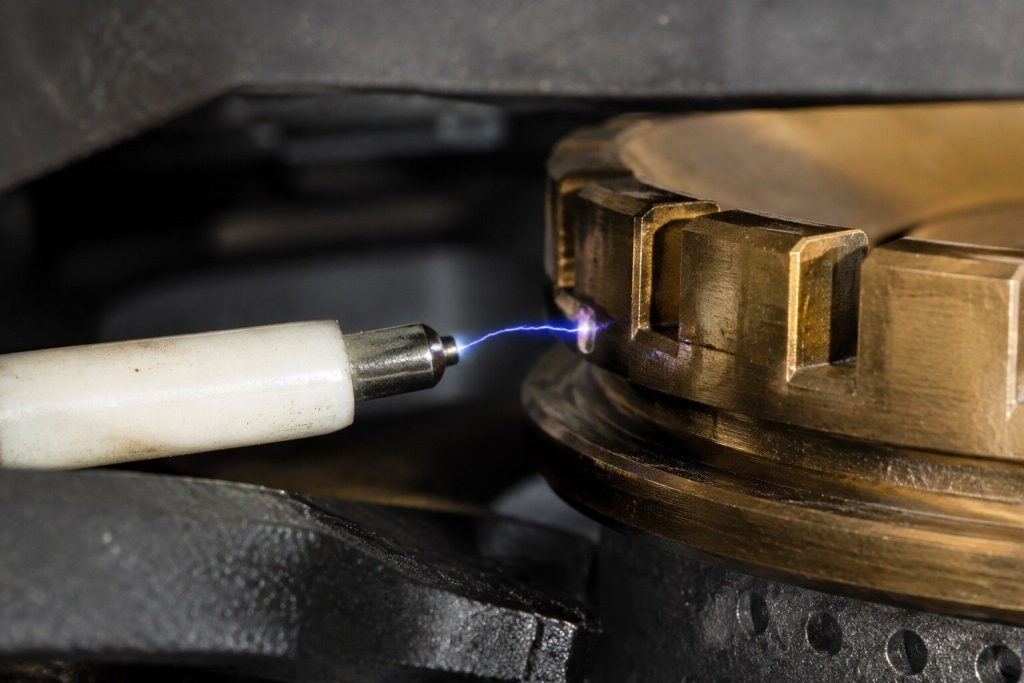
The spark is there and the flame is not Burner clicks but will not ignite
Continuous clicking with no flame — or clicking that carries on after a burner has lit — is one of the two or three most common calls on any gas range, and on this one it has a short list of causes. It is also the symptom people live with longest, and it should not be: every click is unlit gas.
- Clicking after ignition is usually a wet or dirty electrode
- Clicking on every burner at once points at the module
- It is a small part and a same-visit job in most cases
-
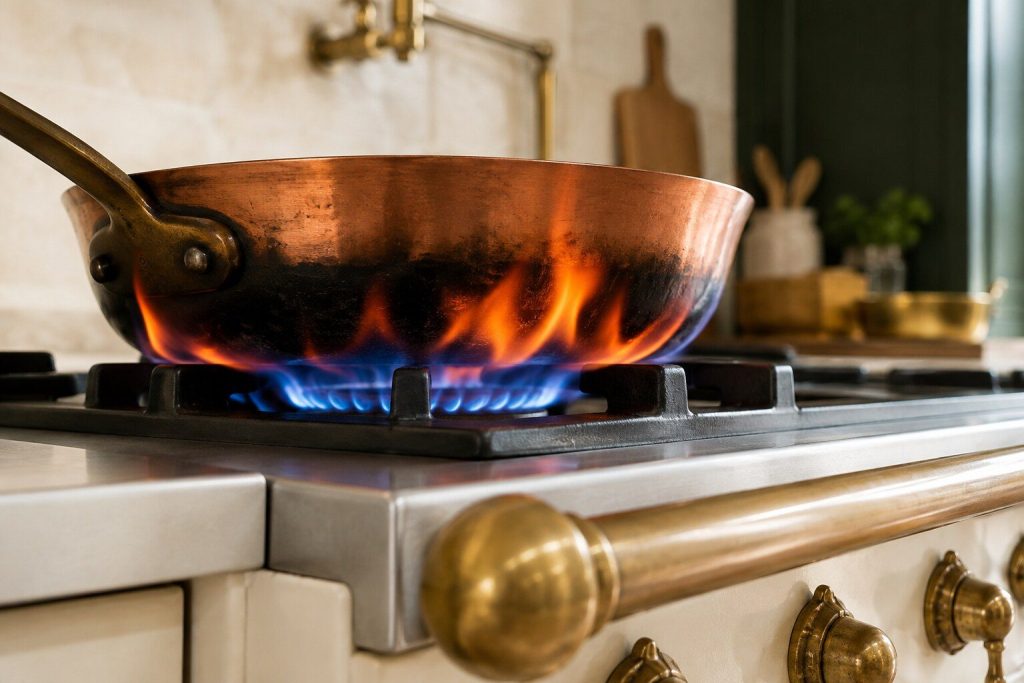
The flame is the wrong color Yellow or orange flame
A gas flame on this range should be blue with a defined inner cone. Yellow or orange tips, soot on the bottom of a pan and a smell of unburnt gas mean the air-to-gas mixture is wrong, and on a range that has moved house or changed fuel that has a specific and common cause.
- Blue is correct — yellow is an air, fuel or orifice problem
- A bad propane conversion is the leading cause on a relocated range
- Soot on a pan bottom is the symptom people notice first
-
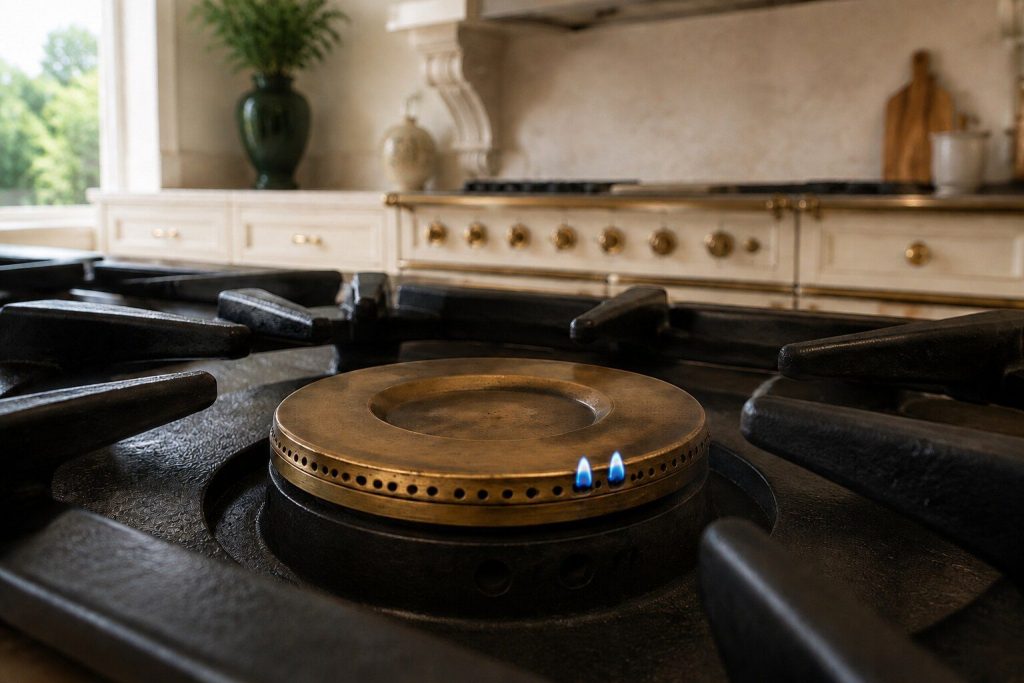
It lights and then goes out Burner will not stay lit
A burner that lights while the knob is held and dies when it is released is a flame supervision failure, and it is the same problem whether it happens on a surface burner or in the oven. The safety system is doing what it exists to do; the reason it no longer trusts the flame is what needs finding.
- The safety chain is working — it just no longer sees the flame
- Thermocouple, then valve, in that order
- An oven that does this is a same-day call
-
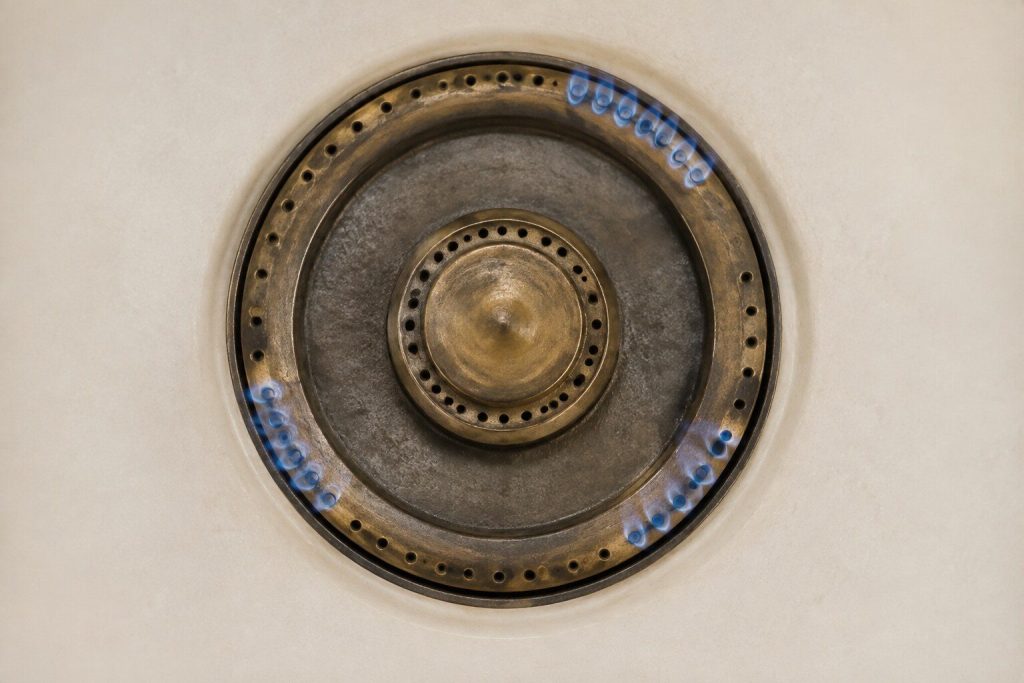
It lights, but there is no heat in it Weak or uneven flame
A burner that lights cleanly and produces half the heat it used to, or a flame that is tall on one side of the crown and absent on the other. On a range whose front burners are rated at 17,000 BTU and whose power burner is rated at 22,000, a weak flame is not a small loss — it changes what the range can do.
- Uneven around the crown is ports or a misseated cap
- Weak on every burner is supply pressure or a regulator
- The plaque burner is the one nobody notices has weakened
-
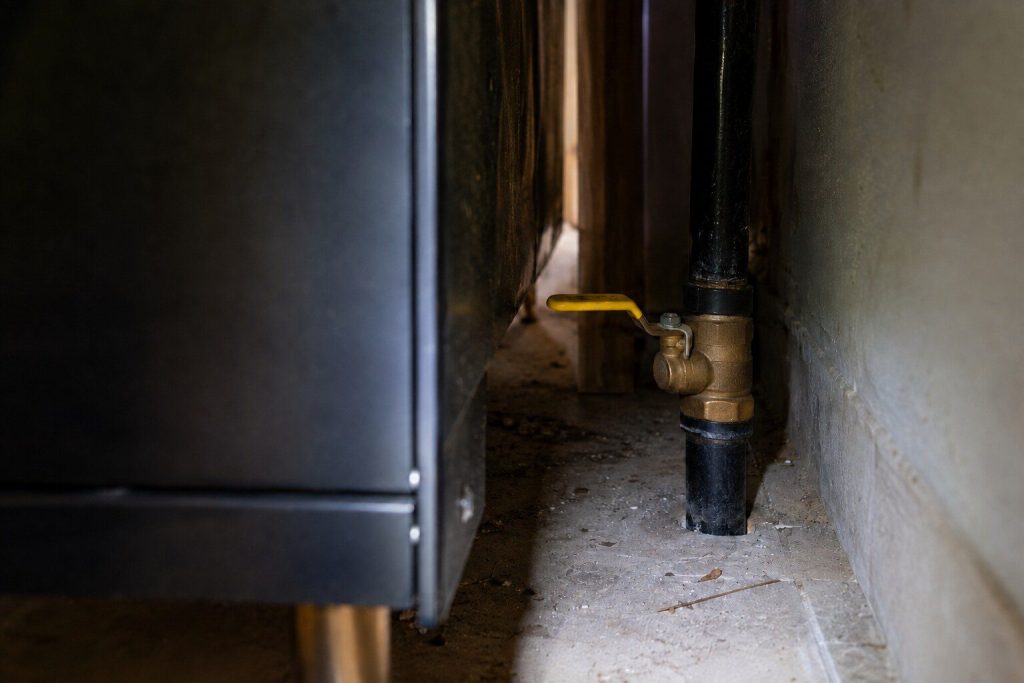
Stop and read this first Gas smell in the kitchen
A smell of gas is the one symptom on this site with instructions rather than a diagnosis. Turn the range off at its shut-off valve, open windows, do not operate switches or the hood, and get everyone out if the smell is strong. Then call the gas utility or 911 first and us second.
- Utility or 911 first, appliance repair second
- Do not operate switches, the hood or a phone in the room
- A faint smell only while lighting is a different matter from a persistent one
-
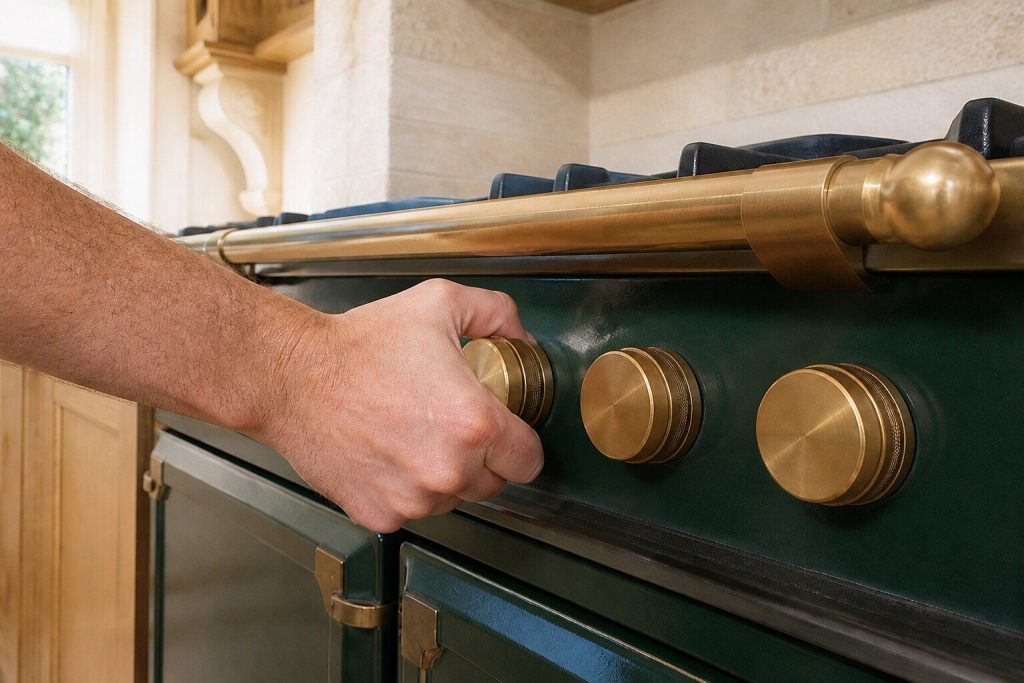
It turns, but not easily Stiff or stuck burner knob
Brass knobs on mechanical valves, used several times a day for years in a humid kitchen. Stiffness is the early warning and it is worth acting on: the failure mode of a stiff valve is not that it becomes hard to turn, but that one day it stops where it is.
- A stiff valve is failing, not dry
- A knob that will not return cleanly to off is urgent
- Every valve gets worked, not only the one complained about
The gas half
No display is not a symptom
Every gas Château, every gas rangetop and both vaulted gas ovens publish nothing — no code, no display, no stored history — and that is normal for this make rather than a sign the electronics have died. An oven that will not light is diagnosed with a clamp meter on the igniter circuit, a millivolt reading across the flame supervision and a functional test on the safety valve. Start from what the appliance is doing.
Before you look it up
Questions about codes and indicators
What does E2 mean on my La Cornue?
The electronic unit under the induction hob is too hot, and it has shut the zones down to protect itself. The maker's own guide gives two causes in this order: the installation of the cooker and whether there is sufficient ventilation, and then — in extreme cases — a cooking utensil allowed to boil dry. So the first thing to look at is what is packed into the cabinet under the cooktop, not the price of a board. What we will not do is clear it and hand the range back, because repeated overheating destroys the board the code is protecting.
I have a U400 and the hob will not run at all.
U400 is the maker's own wording for a cooker that has been incorrectly connected. The control switches off after about a second and the code then stays on the display permanently by design, so there is nothing to reset. In practice it turns up after something changed — a new installation, a breaker or panel replaced, the range moved, electrical work in the kitchen — and it is one of very few messages here where the honest answer may be that nothing inside your range is broken.
My range shows nothing at all. Is the control dead?
Probably not, and on a gas Château there is no control to be dead: those ranges have no display and never did. On an induction hob, a completely dead display is attributed by the maker's own guide to over-voltage or loss of supply voltage — so the checks are the breaker, the isolating switch and the supply, upstream of the appliance. Worth ruling out before anybody books anything.
Why are there only three codes when other brands have dozens?
Because that is what La Cornue publishes. Most of this line is mechanical: brass valves, thermocouples, safety valves, an igniter, a thermostat, a cast-iron plate. There is no control board on a gas Château to raise a code, and the company's own Château guide contains no troubleshooting section at all. A longer list on this site would mean we had made one up.
In more detail
How to read a La Cornue display, and what to do when there is not one
The three codes, in the maker’s own words
E2 — the electronic unit is too hot; check the installation of the cooker and whether there is sufficient ventilation, and note that a utensil boiled dry can also produce it. U400 — the cooker has been incorrectly connected; the control switches off after about a second and the code is then permanently displayed. Er followed by a number — an internal problem the user cannot put right, which means a technician rather than a reset. That is the complete published set, and every one of the three belongs to the induction electronics.
The indicators, which are not codes
The hob display also shows H for residual heat above 140 °F, a pan-missing symbol when a zone has no pan or a pan below its minimum base diameter, A for automatic heat-up, L for child lock, L1 and L2 for the low and simmer settings, and P for power boost. Those are the oven and hob symbols people actually search for, and none of them means anything has failed. The published minimum pan bases are 4¾ inches at the front left, 5½ at the rear zones and 8¼ at the center.
And the nineteen conditions the guides describe in sentences
No display at all, a fuse or residual-current device tripping repeatedly, a hob that will not switch on, a crack in the hob surface, scratches, pan noise, a burner that dies when the knob is released, burners that will not light after cleaning, an excessively hot fascia pointing at a failed cooling fan, hot knobs, steam at the rear grille, a noisy oven fan, an oven not coming on, an oven getting hotter as the range ages, uneven cooking, food cooking too slowly, and the oven lamp. Each one is published here under the maker’s own description, with the guide it came from named on the page — because a documented condition is worth more than an invented code.
A code, or nothing at all — either way, tell us the model.
Photograph the display if there is one and write an Er number down exactly. On a gas range the model code and the configuration are worth more than any display would be.
This article is based on:
- Official manufacturer documentation
- Internal repair procedures
- Technician repair history
- Company quality standards