- “The symptom is usually cooking, not a visible gap”
- “Seal, catch and hinge are adjusted as one system”
- “Measured hot — everything fits differently at temperature”
Symptom
La Cornue oven door will not seal
Long preheats, a cool front shelf, browning on one side, a kitchen that gets hotter than it should while the oven runs. On a vaulted oven the door is part of the cooking mass, so a seal that no longer meets its frame is a cooking complaint long before it is a visible leak.
- From $95 diagnostic, credited to the repair
- 59 cities and neighborhoods covered
- OEM parts available on order
- In writing the price, before anything is opened
Five ordinary causes
What this usually turns out to be
Cheapest and commonest first, which is also the order we check them in. They sit hundreds of dollars apart, and only the unit settles which one is yours.
-
A hardened or flattened seal
Years of heat cycles. It can look perfectly intact and be doing nothing.
Oven door seal and hinge service from $215 -
A catch out of adjustment
The manual's own point: the door has to be held firmly against the seal, and the catch is what does that.
Oven door seal and hinge service from $215 -
Tired hinges or springs
A heavy door no longer lands where the catch expects it.
Oven door seal and hinge service from $215 -
A seal displaced from its channel
Often after a cleaning. It looks fine from the front.
Oven door seal and hinge service from $215 -
A distorted door or frame
Rare, and usually from impact or from something having been forced. Assessed rather than assumed.
Enamel panel and trim service from $265
In five minutes
Before you call anybody
None of it needs tools, and all of it makes the visit shorter.
-
01
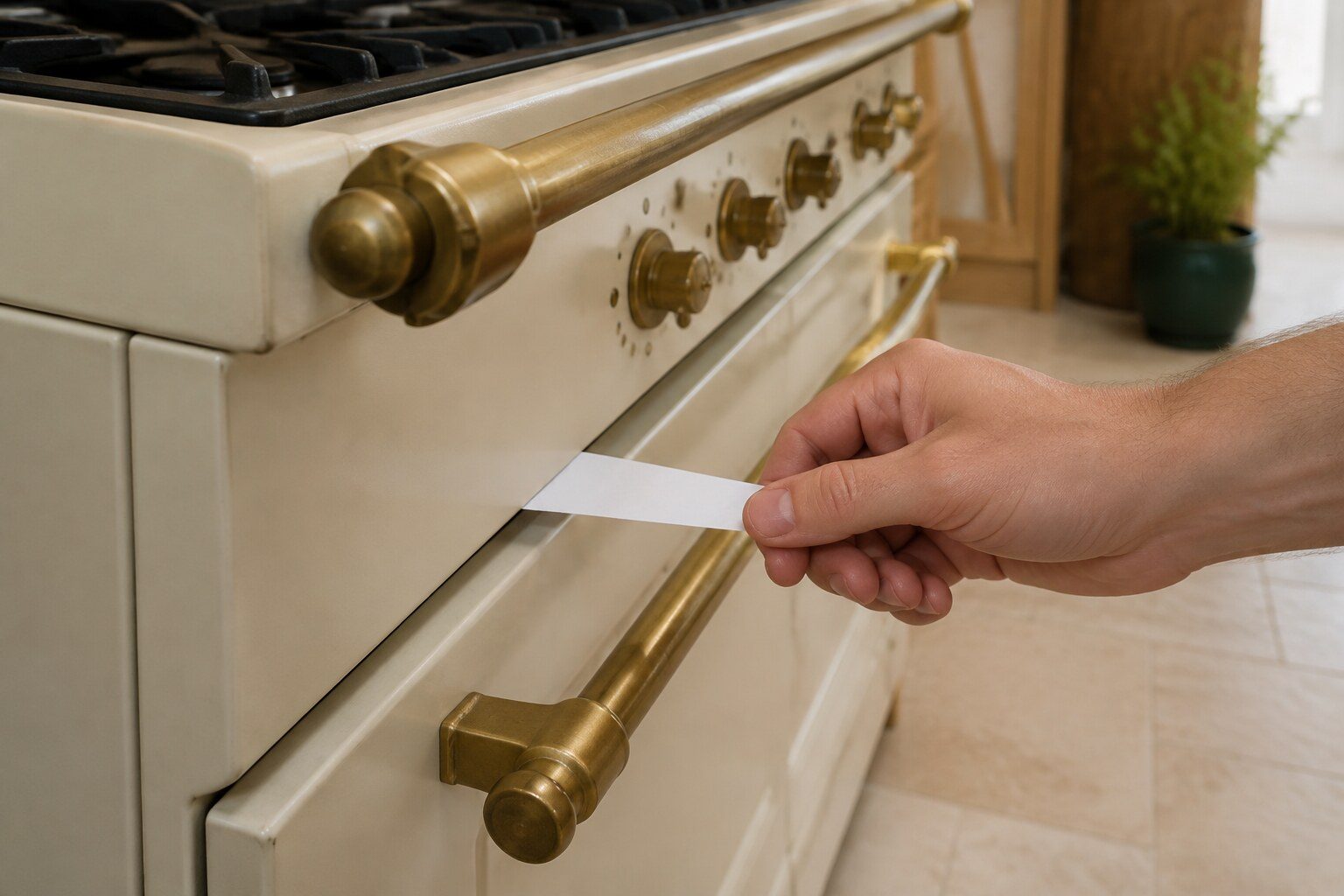
Paper test all the way round
Eight to ten points, not two. The pattern is the answer.
-
02
Look along the closed door in daylight
A gap at one corner is visible from the side if you get your eye down to it.
-
03
Feel for heat while it runs
Back of the hand a few inches from the door, around the perimeter. Do not touch it.
-
04
Check the seal is in its channel
Particularly after any recent cleaning.
How it shows up
What people describe when they call

A shortcut
Narrow it down before anybody arrives
A description of the behaviour leaves a few possible causes. A code names the subsystem before anybody opens anything, which is why it is worth photographing before it clears.
If there is no code at all
On a range, the data plate is behind the kick panel or on the frame under the oven door. On a wall oven, the data plate is on the side of the opening behind the door. All models
In more detail
About La Cornue oven door will not seal
The paper test, done properly
Close a strip of paper in the door and pull it out, at eight or ten points around the whole perimeter — top corners, middle of each side, bottom. Everywhere it grips, the seal is working. Everywhere it slides out freely, it is not, and the pattern tells you what is wrong: loose along the top edge is usually a hinge or a catch, loose in one corner is usually the seal itself, and loose all the way round is a catch out of adjustment.
What it usually means, by the kind of La Cornue appliance
La Cornue sells one appliance in several forms, and the same behavior points at different things on each of them. A built-in side-by-side and an integrated column are not the same service situation, and a dual-fuel range and an induction range fail in different halves.
- Château vaulted gas oven — A heavy insulated door with no window, on hinges that carry real weight. Settling over years is normal wear.
- Château vaulted electric oven — Same door architecture on the other side of the range, and it wears independently.
- CornuFé and Tourelle — Lighter doors with glass, and a seal that hardens rather than a hinge that sags.
Why this shows up as a cooking problem
A vaulted oven works by holding heat in a mass, and the door is part of that mass. A seal that has stopped meeting its frame along the top edge does not produce a dramatic plume of heat — it produces an oven that takes longer to come up, sits a little below its setting, recovers slowly and browns unevenly, all of which get described as an oven that is losing its power. That is why the diagnostic on a temperature complaint starts at the door: it is free to test and it is the cause more often than anything with a part number.
Adjusted as one thing
The seal, the catch and the hinges are a single system and adjusting one without the others is how this comes back. A new seal on a tired hinge is compressed unevenly and hardens early. A catch tightened onto a flattened seal makes the door hard to open and does not seal any better. So the job measures the heat loss around the perimeter hot, corrects the hinge geometry first, then the catch, then replaces the seal if it is genuinely finished — and measures again hot, because everything on this door fits differently at temperature than it does cold.
This article is based on:
- Official manufacturer documentation
- Internal repair procedures
- Technician repair history
- Company quality standards
Before you book
Questions about La Cornue oven door will not seal
The door has always been stiff to open. Is that related?
It can be the same adjustment seen from the other side. A catch pulling the door too hard onto a seal that has hardened makes for a stiff door and, oddly, can still seal badly at the corners — the door pivots on the middle of the seal instead of landing flat. So stiff and leaky are not contradictory, and both are fixed by getting the hinge geometry and catch right rather than by tightening something. Worth mentioning when you book.
Can I replace the seal myself?
On the lighter CornuFé and Tourelle doors, a seal that has simply come out of its channel is often a genuine five-minute job and we will happily tell you so on the phone. On a Château we would rather do it: the doors are heavy, the hinges are under tension, the seal has to be seated evenly to compress evenly, and the catch usually needs setting afterwards. A seal fitted without adjusting the catch and hinges is the commonest reason a door still leaks after a new seal.
Where we do it
Across Miami-Dade, Broward, and Palm Beach
Same terms everywhere we go: an on-site diagnostic first, the price agreed in writing, and the exact figure confirmed once we have seen the unit.
Neighborhoods people ask for by name