Troubleshooting
Your Oven Has Not Broken, It Has Drifted: Testing a Thermostat
Put an oven thermometer on the middle shelf, set 350 °F, and read it every ten minutes for forty. Two numbers matter and they mean different things: how far it overshoots on the way up, and what it settles at. An oven that spikes to 425 °F and settles at 350 is behaving normally and needs nothing. One that settles at 390 has drifted, and La Cornue's own guide names both the symptom and the answer — if turning the temperature down has not worked, or has only worked for a short time, you may need a new thermostat, fitted by a service person. Before concluding that, rule out the free causes the maker also lists: the range being out of level, a door seal that no longer holds, and a tray larger than the specified size. And on a dual-fuel range test both ovens, because each has its own thermostat and they drift independently.
The full guide
La Cornue oven thermostat: the most quietly expensive problem on this appliance
Not expensive to fix. Expensive in wasted food, wasted afternoons and three years of a cook slowly rewriting recipes around an oven that has stopped telling the truth.
La Cornue's own troubleshooting section names it in one sentence, and the sentence is unusually diagnostic for a manual: *if turning the temperature down using the oven control knob has not worked, or has only worked for a short time, then you may need a new thermostat.* It adds that it should be fitted by a service technician.
That is the whole official answer. What follows is how to find out whether it applies to you.
Two numbers, not one
An oven has two behaviors that people both describe as "running hot", and they are different problems.
Overshoot. On the way up, a thermostat lets the oven pass the setting before it cuts. A vaulted oven with real mass can spike to 425 °F on the way to 350 and then settle. That is normal, it is not a problem, and it is why food put in the moment the oven reaches temperature can catch.
Settled temperature. What it holds once it has stopped climbing. This is the number that matters. An oven that settles at 390 with 350 on the dial has drifted, whatever it did on the way there.
One reading tells you neither. Reading every ten minutes for forty tells you both, and the pattern is the diagnosis.
Do the free checks first
All three are in the maker's own troubleshooting section, all three produce the same complaint, and all three cost nothing.
Level. A dish of water on the middle shelf should sit at one depth all over. Deeper at the back means the back of the range needs raising or the front lowering — the legs are adjustable across a specified range. We find ranges that were slid into place, connected and never leveled.
The door seal. Close a strip of paper in the door and pull it out at eight or ten points around the perimeter. Where it grips, the seal works; where it slides out freely, it does not. On a vaulted oven the door is part of the cooking mass, so a leaking seal presents as an oven that will not hold its setting.
Tray size and loading. Nothing bigger than the specified size, placed centrally, and room left between two loaded shelves.
An oven that fails any of these does not have a thermostat problem yet.
Then measure it properly
Thermometer on the middle shelf. Set 350 °F. Read at ten, twenty, thirty and forty minutes. Write the numbers down.
Then do it again at 450 °F, because an oven can be accurate in the middle of its range and short at the top — and that is exactly where roasting complaints come from. An oven with no headroom left at high heat is a real problem even if 350 is perfect.
On a dual-fuel range, do both sides. Each cavity has its own thermostat and they drift independently, so a range can carry one perfectly calibrated oven and one thirty degrees out. Whichever one you bake in is the one you know about.
Calibration, or a part
Some thermostats on this make can be adjusted and some cannot. Even where adjustment is possible, a thermostat that has drifted a long way has usually drifted because it is wearing rather than because it was set wrong — so adjusting it buys a season and then you are back.
What a good report gives you is which of the two applies, the reason, and the before and after figures. That last part is not bureaucracy. It is the only record of what changed in your kitchen.
The warning nobody gives you
An oven that has run thirty degrees hot for three years has a cook who has adapted completely: shorter times, lower settings, recipes annotated in pencil.
Put the oven right and every one of those adaptations becomes an error in the other direction. Cakes that were perfect are now underdone. The roast that took two hours takes two and a quarter.
We say this before doing the work rather than after, and we leave the measurements so there is a record. It is a fortnight of recalibrating the cook, and then you have an oven you can trust for another decade.
One thing that is not the thermostat
Uneven cooking. A vaulted oven is graded by design — radiant heat from a heavy sealed dome, hottest towards the center and back — and the maker's own notes ask you to turn a large item during cooking. An oven can be perfectly calibrated and still not bake evenly on two loaded shelves, and no thermostat will change that.
Calibration is about *what temperature*. Distribution is about *where*. They have different pages and different repairs.
If it turns out to be a repair
What this leads to, and what it costs
Every job on this site is priced the same way: an on-site diagnostic first, the figure agreed in writing before anybody starts.
-
Oven runs hot
An oven that has drifted upwards over years, and a cook who has quietly rewritten every recipe around it. The manual is explicit: an oven that gets hotter as the range gets older, and does not come back when the dial is turned down, wants a new thermostat rather than a new habit.
- The maker's own guide names this and names the answer
- Measured through a full cycle, not with one reading
- A corrected oven changes your cooking — expect that
-
Oven thermostat calibration
An oven that has drifted hot over years, and a cook who has quietly rewritten every recipe around it. The manual is explicit: an oven that gets hotter as the range ages and does not come back when the dial is turned down wants a thermostat, not a new habit.
- Measured with a calibrated probe through a full cycle
- Drift distinguished from a vaulted oven's designed unevenness
- The owner warned that a corrected oven changes their cooking
-
La Cornue oven: an oven that has drifted hot over the years wants a thermostat, in the maker’s own words
La Cornue — an indicator rather than a code. This is the closest thing La Cornue publishes to a diagnosis, and it is a good one: if turning the temperature down with the oven control knob has not worked, or has only worked for a short time, then you may need a new thermostat — and the guide says it should be fitted by a service person.
What the machine is telling you
Questions people ask about this
Can I just cook 25 degrees lower?
You can, and many people do for years. Two arguments against. A drifting thermostat rarely stops drifting, so this year's offset is wrong next year and you are permanently chasing it. And the top of the range matters: an oven reading 350 while delivering 390 has no headroom left at 500, so anything needing real heat becomes unpredictable.
Will my baking change after it is fixed?
Yes, and it is the thing nobody warns about. Three years of learned adjustments become errors in the other direction the moment the oven is correct. Ask for the before and after measurements in writing — a good report carries both — so you know exactly how much to unlearn.
Can a thermostat be calibrated instead of replaced?
Sometimes. Some thermostats on this make adjust and some do not, and even where adjustment is possible a thermostat that has drifted a long way has usually drifted because it is wearing rather than because it was set wrong. Adjusting a failing one buys a season. A good report says which of the two you have and why.
It burns things on the bottom specifically.
That is distribution rather than calibration, and it has cheaper causes. A tray larger than the specified size blocks what circulation the cavity has. An unlevel range puts food closer to one radiating surface. And on the gas side the burner is beneath, so scorching underneath with a correct average points at the burner or the diffuser rather than at the control.
Troubleshooting
More guides like this one
-
Resetting an Oven Control, and When Resetting Is the Wrong Move
The internet's answer to every appliance message is to reset it. On this make there is one code where doing that repeatedly is what destroys the board it protects.
Read more -
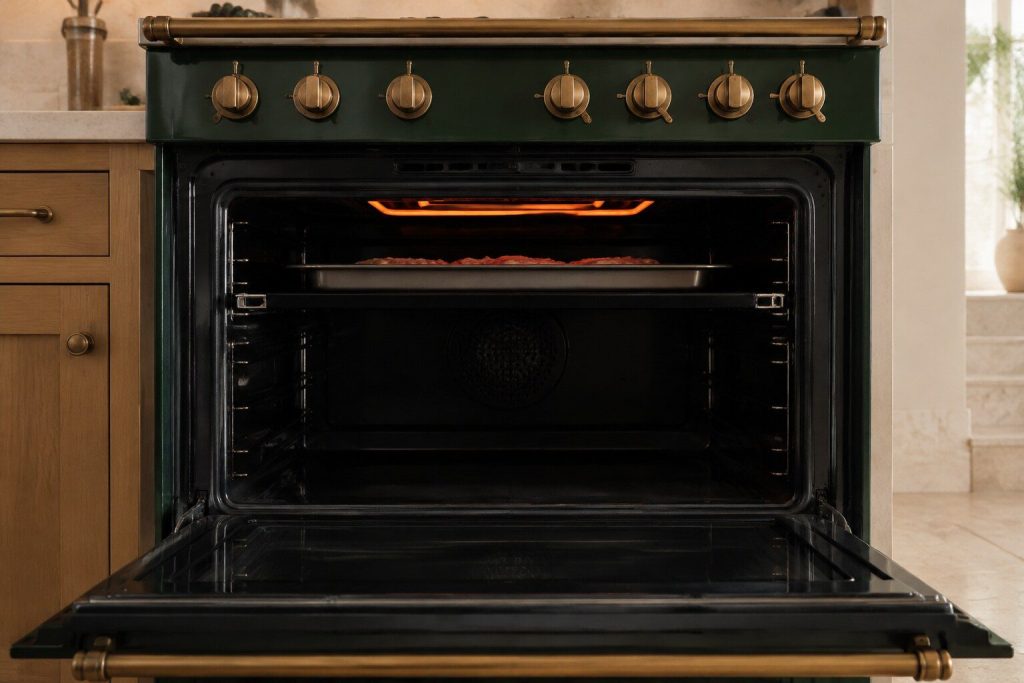
The Broil Symbol on a La Cornue, and Why Browning Fails on Its Own
Every vaulted gas oven here has an electric broiler over a gas burner. Two circuits in one cavity — so an oven can brown beautifully and refuse to bake.
Read more -
Finding the Right La Cornue Manual, and What Is Actually in It
The guides are per model and per fuel, and reading the wrong one gives you the wrong troubleshooting section — and in one case a European lamp voltage.
Read more
Tell us the model number and what it is doing.
This article is based on:
- Official manufacturer documentation
- Internal repair procedures
- Technician repair history
- Company quality standards