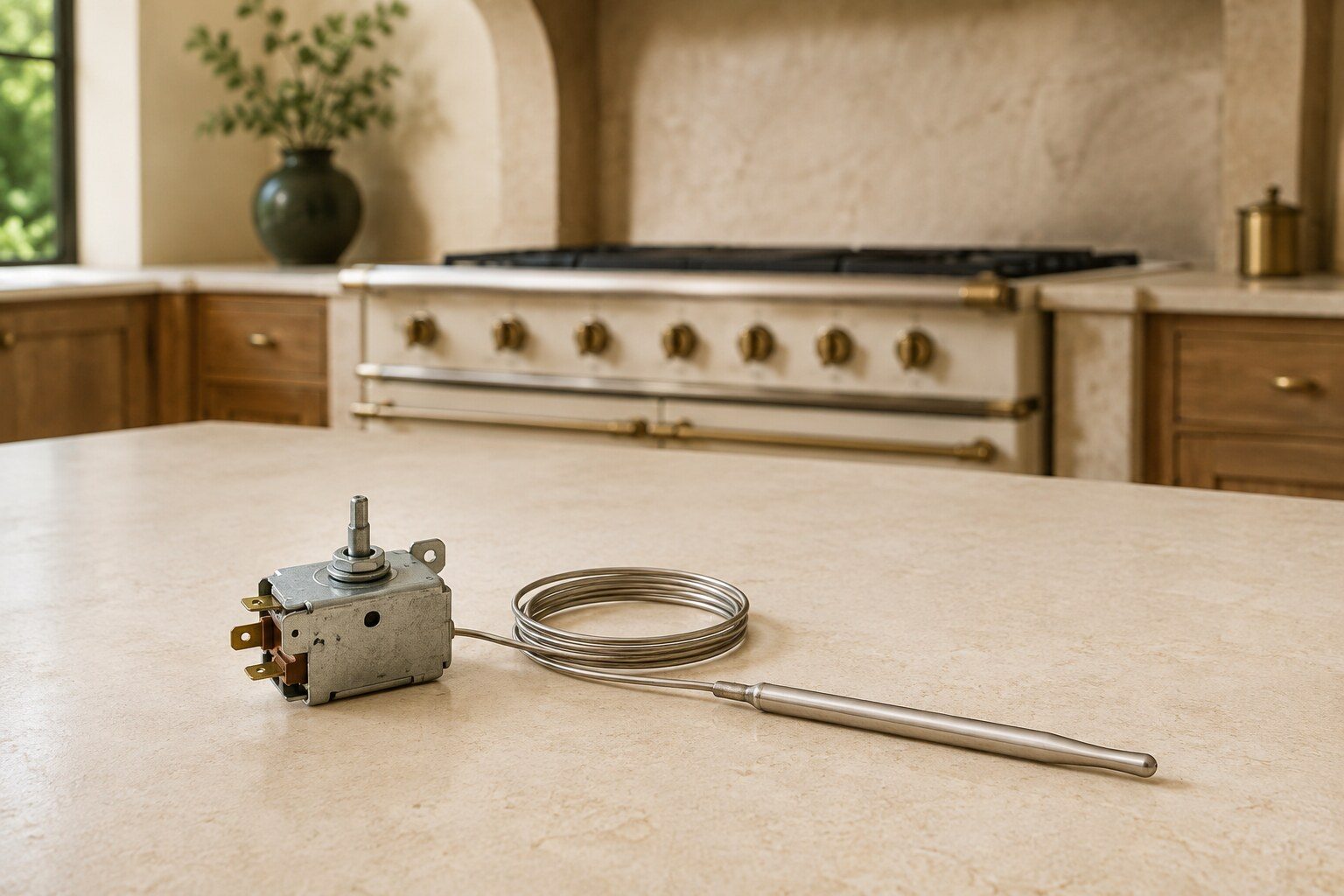
Cost Expectations
What an Oven Thermostat Costs to Put Right, and What Sets the Figure
Our work on this starts from $185, and parts are quoted separately once the diagnostic has established what is needed — because the honest answer is that a good share of these visits end in calibration rather than a part. What moves the figure: whether the thermostat on your model can be adjusted at all, which oven it is (a dual-fuel range has two, and they drift independently), whether the problem is actually the sensor rather than the thermostat on an electric oven, and whether a part has to come from the maker. Before any of that, three free checks come first because they produce the same complaint: the range being out of level, a door seal that no longer holds, and a tray larger than the specified size. La Cornue's own guide names the thermostat only after those, and it says an oven that gets hotter with age and does not come back when the dial is turned down may need a new one.
The full guide
Oven thermostat replacement cost: the question with no brand attached
People search for this before they know who to call: oven thermostat replacement cost, oven thermostat repair cost, gas oven thermostat replacement cost. No manufacturer in the query, because at that point the appliance is just "the oven".
So this page answers it generally first, then says what is different about doing it on a La Cornue.
Why nobody can give you one number honestly
Because the same complaint ends three different ways.
Calibration. Some thermostats can be adjusted. Where that is possible and the drift is modest, the visit is measurement, adjustment and measurement again, with the before and after figures in the report. No part.
Replacement. A thermostat that has drifted a long way has usually drifted because it is wearing, and adjusting a failing one buys a season. Then it is a part, and on this make a part is sometimes stocked and sometimes made to order.
Neither. Which is more common than people expect: the complaint turns out to be an unlevel range, a door seal that has stopped meeting its frame, or a tray blocking what circulation the cavity has. All three produce "my oven runs hot" and none of them is a thermostat.
Anybody quoting a fixed figure over the phone is quoting for one of those three and hoping.
What moves the figure
Whether it adjusts. Model-dependent, and it is the single biggest variable.
Which oven. On a dual-fuel Château there are two ovens with two thermostats that drift independently. A range can carry one perfectly calibrated oven and one thirty degrees out, and the owner only knows about the one they bake in. Testing both is part of the visit, and it occasionally doubles the work — while saving a second call-out.
Thermostat or sensor. On an electric oven the same symptom can come from a sensor reading low: the oven is not lying on purpose, it genuinely believes it is cooler than it is. Different part, similar figure, and it needs measuring rather than guessing.
Parts availability. Common items are sourced domestically and are same-week. A thermostat specific to one configuration, or to a discontinued model, is an order with a lead time — quoted before ordering rather than discovered afterwards.
What else is found. A thermostat replaced on an oven whose door seal is finished will still produce a cooking complaint. A good diagnostic reports both and lets you decide the order.
The free checks, which come first
All three are in La Cornue's own troubleshooting section, and it names the thermostat only after them.
Level. A dish of water on the middle shelf should sit at one depth all over. Deeper at the back means the back of the range needs raising or the front lowering — the legs are adjustable. We find ranges that were slid into place, connected and never leveled.
The door seal. Close a strip of paper in the door and pull it out at eight or ten points around the perimeter. Where it slides out freely, the seal is not sealing there. On a vaulted oven the door is part of the cooking mass, so a leak presents as an oven that cannot hold its setting.
Tray size and loading. Nothing bigger than the specified size, placed centrally, room between two loaded shelves.
Do those before you book anything. They cost nothing and they are the answer often enough to be worth an hour of your Saturday.
The measurement that decides it
Thermometer on the middle shelf. Set 350 °F. Read at ten, twenty, thirty and forty minutes.
Overshoot then settle — spiking to 425 on the way to 350 and coming back — is normal on an oven with real mass. Nothing to fix.
Settles high — 390 with 350 on the dial — is drift, and that is what the maker's own guide describes: if turning the temperature down has not worked, or has only worked for a short time, you may need a new thermostat.
Then repeat at 450 °F, because an oven can be accurate mid-range and short at the top. That is where roasting complaints live and where a lost headroom shows up.
The cost nobody prices: your recipes
An oven that has run thirty degrees hot for three years has a cook who has adapted entirely — shorter times, lower settings, notes in the margins.
Correct the oven and every one of those adaptations becomes an error in the other direction, for a fortnight or so. It is not a reason to leave it wrong; it is a reason to ask for the before and after measurements in writing, so there is a record of exactly what changed.
We say this before doing the work rather than after.
Our figure, and what it includes
From $185 for the work: a full-cycle probe test before, the free causes ruled out, adjustment where adjustment is possible, and a second full-cycle test after with both sets of figures in the report. On a dual-fuel range, both ovens tested.
Parts on top, quoted with the lead time once the diagnostic knows what is actually needed. Every figure on this site is a starting point rather than a quote, and the reasoning behind each one is written down in our own pricing file.
If it turns out to be a repair
What this leads to, and what it costs
Every job on this site is priced the same way: an on-site diagnostic first, the figure agreed in writing before anybody starts.
-
Oven thermostat calibration
An oven that has drifted hot over years, and a cook who has quietly rewritten every recipe around it. The manual is explicit: an oven that gets hotter as the range ages and does not come back when the dial is turned down wants a thermostat, not a new habit.
- Measured with a calibrated probe through a full cycle
- Drift distinguished from a vaulted oven's designed unevenness
- The owner warned that a corrected oven changes their cooking
-
Oven runs hot
An oven that has drifted upwards over years, and a cook who has quietly rewritten every recipe around it. The manual is explicit: an oven that gets hotter as the range gets older, and does not come back when the dial is turned down, wants a new thermostat rather than a new habit.
- The maker's own guide names this and names the answer
- Measured through a full cycle, not with one reading
- A corrected oven changes your cooking — expect that
-
La Cornue oven: an oven that has drifted hot over the years wants a thermostat, in the maker’s own words
La Cornue — an indicator rather than a code. This is the closest thing La Cornue publishes to a diagnosis, and it is a good one: if turning the temperature down with the oven control knob has not worked, or has only worked for a short time, then you may need a new thermostat — and the guide says it should be fitted by a service person.
What the machine is telling you
Questions people ask about this
Why can you not quote a single figure?
Because two visits with the same complaint end differently. One is a calibration with the before and after measurements in the report and no part at all. The other is a thermostat that will not come back, on a model where a replacement is a specific part with a lead time. Quoting the second figure to everybody would overcharge half of them; quoting the first would be a number we could not keep.
Is a thermostat worth replacing on an old range?
On this make, almost always. The parts that fail here are a fraction of one per cent of what the range cost, and the parts that would make replacement rational — the body, the cavities, the plaque — do not fail. A twenty-year-old Château with a new thermostat is a functioning appliance for another decade.
Can I fit one myself?
We would not recommend it on the gas side, and that is not commercial caution: an oven thermostat on a gas appliance sits in the gas train, and refitting it means a joint that has to be leak-tested afterwards with instruments. On an electric oven it is a wiring and calibration job rather than a gas one, and the calibration is the part that is hard to do without a probe and a full cycle.
How do I know it is the thermostat and not something else?
Measure it. A thermometer on the middle shelf, 350 °F, read every ten minutes for forty. Overshooting on the way up and settling at the setting is normal. Settling high is drift. And do the free checks first — an unlevel range or a leaking door seal produces the same complaint for no money at all.
Cost Expectations
More guides like this one
-
Why a La Cornue Costs What It Costs, From Somebody Who Repairs Them
A repair company can answer this better than a showroom can, because we see what twenty years does to one. Including the honest counter-argument.
Read more
Tell us the model number and what it is doing.
This article is based on:
- Official manufacturer documentation
- Internal repair procedures
- Technician repair history
- Company quality standards