Troubleshooting
Changing a La Cornue Oven Lamp: the Maker Says This One Is Yours
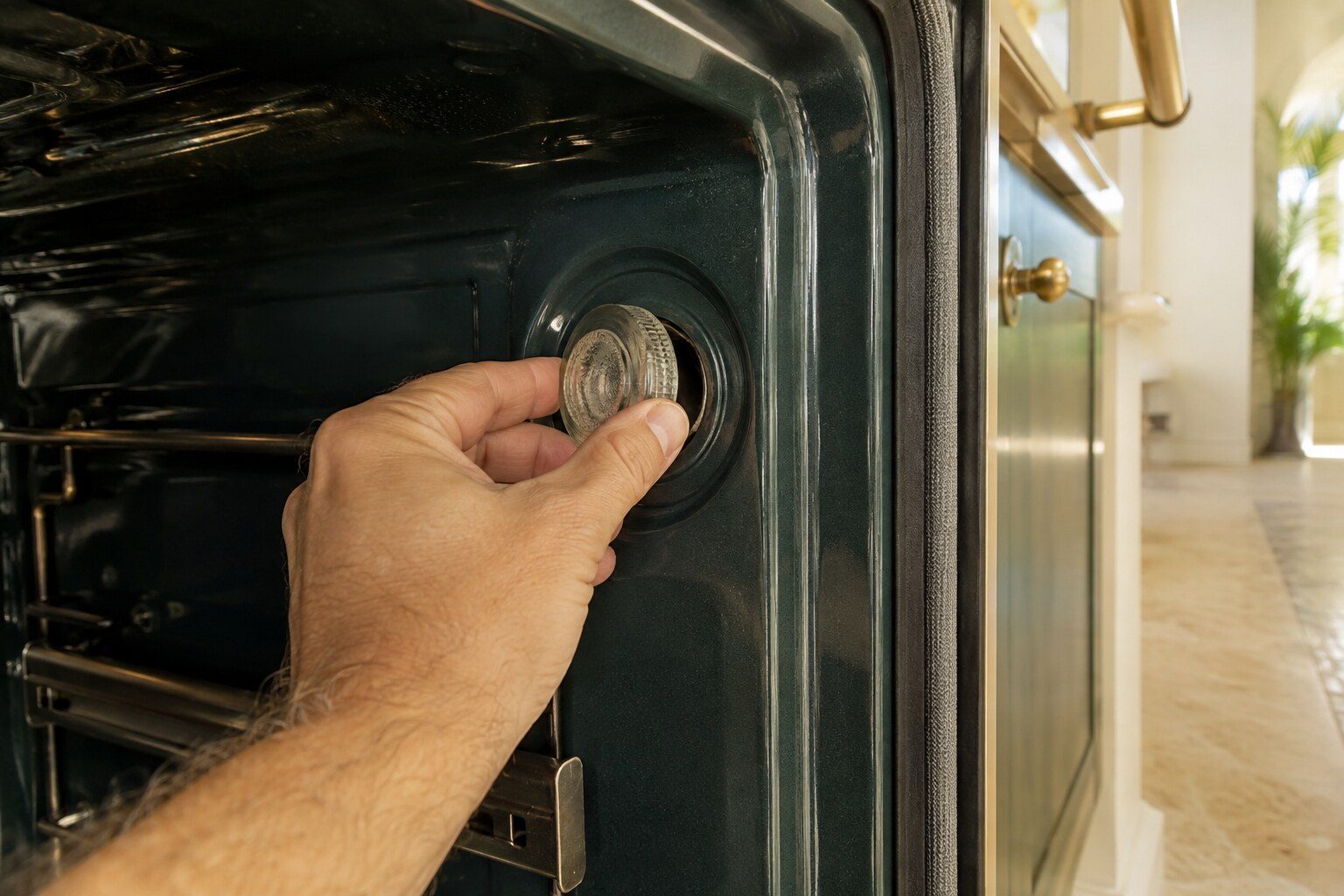
Turn the power off, let the oven cool completely, take the shelves out, and unscrew the bulb cover counter-clockwise — the maker's own guide warns that it may be very stiff. Pull the old lamp straight out and fit the new one with a cloth rather than bare fingers. The lamp is a 40 W halogen with a G9 fitting, and the guide states plainly that it is not covered under the guarantee and can be bought from most electrical stores. On voltage, La Cornue's two guides disagree: its US Albertine guide says 40 W 120 V and its CornuFé 110 guide prints 230 V, which is a European figure. On a US range use the 120 V lamp, and if in any doubt take the old one to the shop. Stop and book a visit if a new lamp does not light, or if two or three went at once — that is a socket or a supply problem rather than bulbs.
The full guide
La Cornue oven light bulb replacement: a repair company telling you not to call one
There are not many jobs on this appliance we would rather you did yourself, and this is one of them. La Cornue's own guide says as much: the bulb has probably blown, you can buy a replacement — which is not covered under the guarantee — from most electrical stores, and what to ask for is a 40 W halogen lamp, G9 fitting.
That is unusually direct for a manufacturer, and it is worth taking at face value.
The voltage, which the maker gets wrong once
Here is the part no summary of the manual will tell you.
The US Albertine guide says: *"Ask for a 40W – 120V halogen lamp (G9)"*.
The CornuFé 110 guide says: *"Ask for a 40 W – 230 V halogen lamp (G9)"* — for the same lamp in the same position.
120 V is the US figure. 230 V is European, and the CornuFé guides are visibly adapted from a European original: the same documents talk about a Residual-Current Device rather than a GFCI, which is a British and European term.
On a range in a US kitchen, buy the 120 V lamp. If you are unsure, take the old one with you — the fitting is the same either way and the shop will match it.
We only know this because every quotation published on this site is checked against the actual PDFs by a script. That run found three of our own misquotations, and it found this: a figure where the manufacturer disagrees with itself.
Doing it
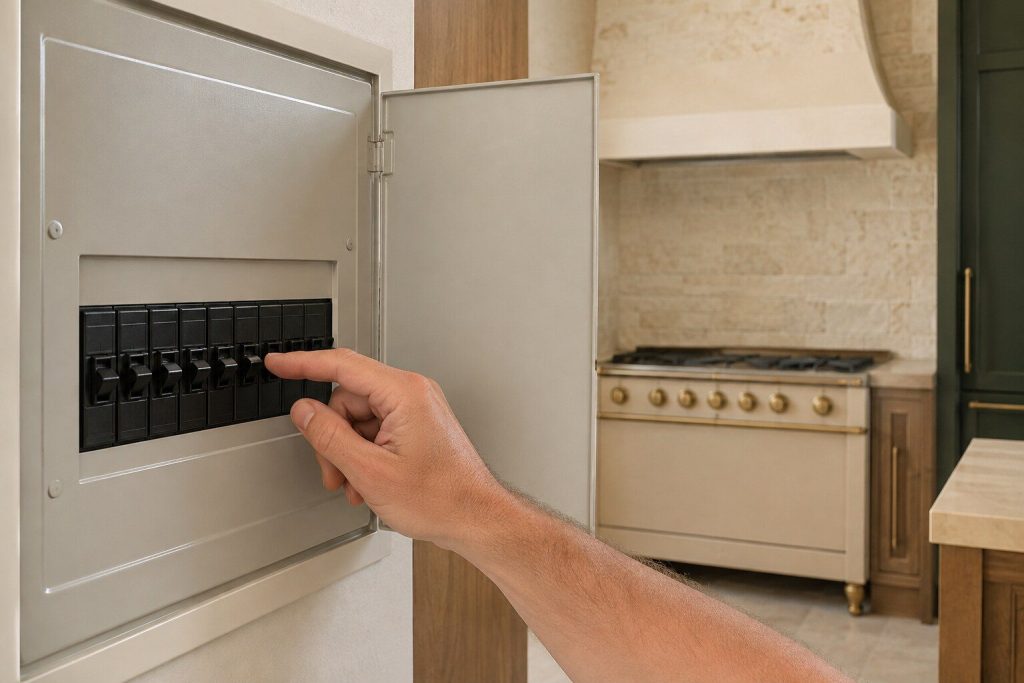
Power off, and cool. At the breaker or the isolating switch. Cool means genuinely cool — a vaulted cavity holds heat for a long time after the range is off, and the lamp sits in the hottest part of it.
Shelves out. The guide asks for this and it is sensible: you need both hands, and shelf runners are at exactly knuckle height.
Cover counter-clockwise, and expect a fight. The manual's own words are that it may be very stiff. It is a glass cover that has been through thousands of heat cycles. A dry rubber glove or a rubber jar opener gives you grip without stressing the glass. Do not use pliers on it.
Lamp straight out. A G9 has two loop pins; it pulls rather than twists.
Handle the new one with a cloth. Fingerprints on halogen glass create a hot spot and shorten its life. It is a small thing and it is why the lamp you fit bare-handed sometimes lasts months rather than years.
Cover back on hand tight, then test before the shelves go back in.
When it is not a lamp
Three situations where the answer is a visit rather than a bulb.
A new lamp does not light. The socket has failed, or the supply to the lamp circuit has. Sockets take the same heat cycles the cover does, and they do fail.
Two or three went at the same time. Bulbs do not fail in sympathy. Simultaneous failures point at the supply.
A lamp that fails repeatedly. A new lamp every few weeks is a socket with a poor connection generating heat, and it will eventually be more than a lamp.
While we are on lights
The hood has them too, and they are a different item: the Château motorized hoods carry three 20-watt high-intensity lamps and the newer inserts use LEDs. Same rule applies — one out is usually a lamp, two or three at once is a socket or supply.
And if the hood's lights work but the fan does not, that is genuinely useful information: it means the supply and part of the control are alive, which narrows a blower problem considerably before anybody arrives.
If it turns out to be a repair
What this leads to, and what it costs
Every job on this site is priced the same way: an on-site diagnostic first, the figure agreed in writing before anybody starts.
-
La Cornue oven: the oven lamp, which the maker states plainly is not a warranty part
La Cornue — an indicator rather than a code. The guide expects the owner to do this one, and says so: the bulb has probably blown, you can buy a replacement — which is not covered under the guarantee — from most electrical stores, and what you ask for is a 40 W 120 V halogen lamp, G9 fitting.
What the machine is telling you -
Hood lighting and remote repair
Three 20-watt high-intensity lamps on the Château hoods, LEDs on the newer inserts, and two separate control paths — in-hood activation and a remote. A hood that answers its own buttons but not the remote is a receiver, not a motor.
- Single lamps are often a customer job and we say so
- Remote and in-hood controls tested as separate paths
- Two or three lamps out at once is a socket or supply problem, not bulbs
-
Ovens
There are three different ovens on this make and they fail in three different ways. The vaulted gas oven cooks by radiant heat inside a sealed dome and has an electric broiler over it. The vaulted electric oven sits on the other side of the same range. And since 2025 there is a standalone one: the Château Tourelle, a fully electric multifunction wall oven in 60 and 75 centimeter widths, built to sit in a cabinet run next to a Château cooktop. Which of the three you have decides everything about the repair.
- Vaulted gas, vaulted electric and the electric Tourelle wall oven
- Gas ovens carry an electric broiler — browning and baking can fail separately
- Thermostat drift is measured against a probe, never adjusted by feel
-
Diagnostic visit
One visit, one technician, one answer in writing. On a make with three error codes in its entire documentation, the diagnostic is not a formality before the repair — it is the repair's only source of information, and it is done with instruments rather than by elimination.
- Measured, not guessed — this make reports almost nothing on its own
- The configuration code read off the range, because it decides the parts
- Written findings and a from-price before anything is opened
Questions people ask about this
Why do the manuals give two different voltages?
Because the CornuFé guides are clearly adapted from a European original — the same documents refer to a Residual-Current Device rather than a GFCI. The US Albertine guide says 40W 120V and the CornuFé 110 guide says 40 W 230 V for the same G9 lamp. On a US range it is the 120 V lamp. We found this by checking every quotation on this site against the actual PDFs, and it is exactly the kind of detail that a summary of a manual loses.
The cover will not budge.
That is expected and the guide says so. It is a glass cover that has been through thousands of heat cycles, it unscrews counter-clockwise, and it usually needs real grip — a clean dry rubber glove or a rubber jar opener gives you that without risking the glass. Never use pliers on it, and never do it while there is any heat in the oven.
The new lamp does not light.
Then stop, because it is no longer a bulb question. Either the socket has failed — they take the same heat cycles the cover does — or the supply to the lamp circuit has. Both are ordinary repairs and both need the oven opened up rather than another bulb bought.
Can I use an LED instead?
We would not, in an oven cavity. A G9 LED is not rated for the ambient temperature inside a working oven, and the failure mode is a lamp that dies quickly or a driver that cooks. The halogen the maker specifies is a consumable that costs very little, and it is specified because of where it lives.
Troubleshooting
More guides like this one
-
Your Oven Has Not Broken, It Has Drifted: Testing a Thermostat
The maker's own guide says an oven that gets hotter with age and does not come back wants a thermostat. What nobody warns you about is that your cooking will change.
Read more -
Resetting an Oven Control, and When Resetting Is the Wrong Move
The internet's answer to every appliance message is to reset it. On this make there is one code where doing that repeatedly is what destroys the board it protects.
Read more -
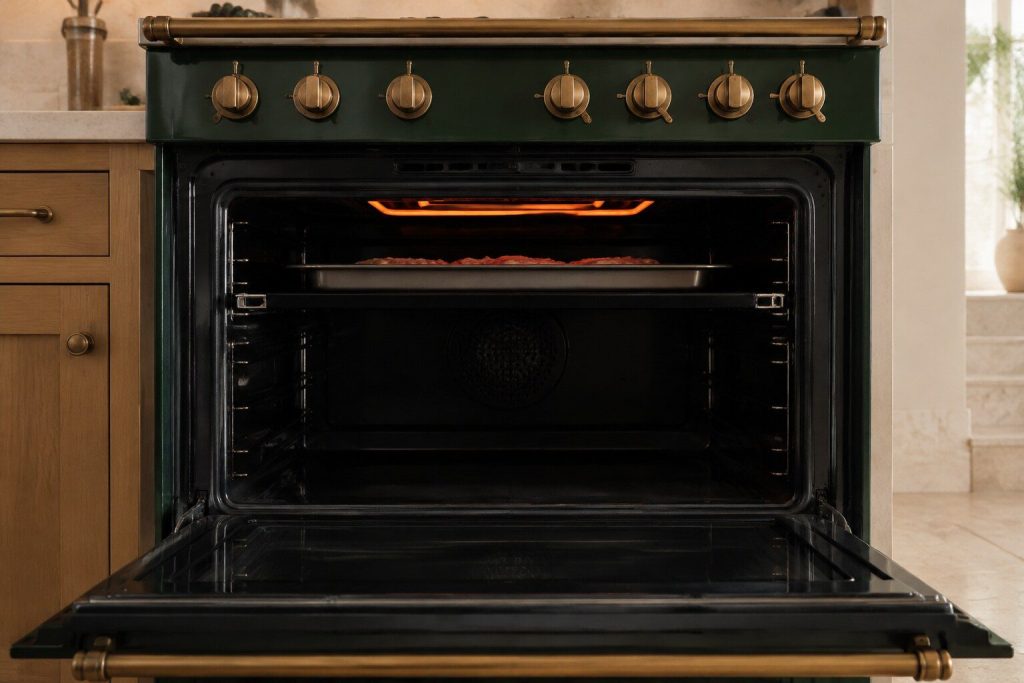
The Broil Symbol on a La Cornue, and Why Browning Fails on Its Own
Every vaulted gas oven here has an electric broiler over a gas burner. Two circuits in one cavity — so an oven can brown beautifully and refuse to bake.
Read more
Tell us the model number and what it is doing.
This article is based on:
- Official manufacturer documentation
- Internal repair procedures
- Technician repair history
- Company quality standards