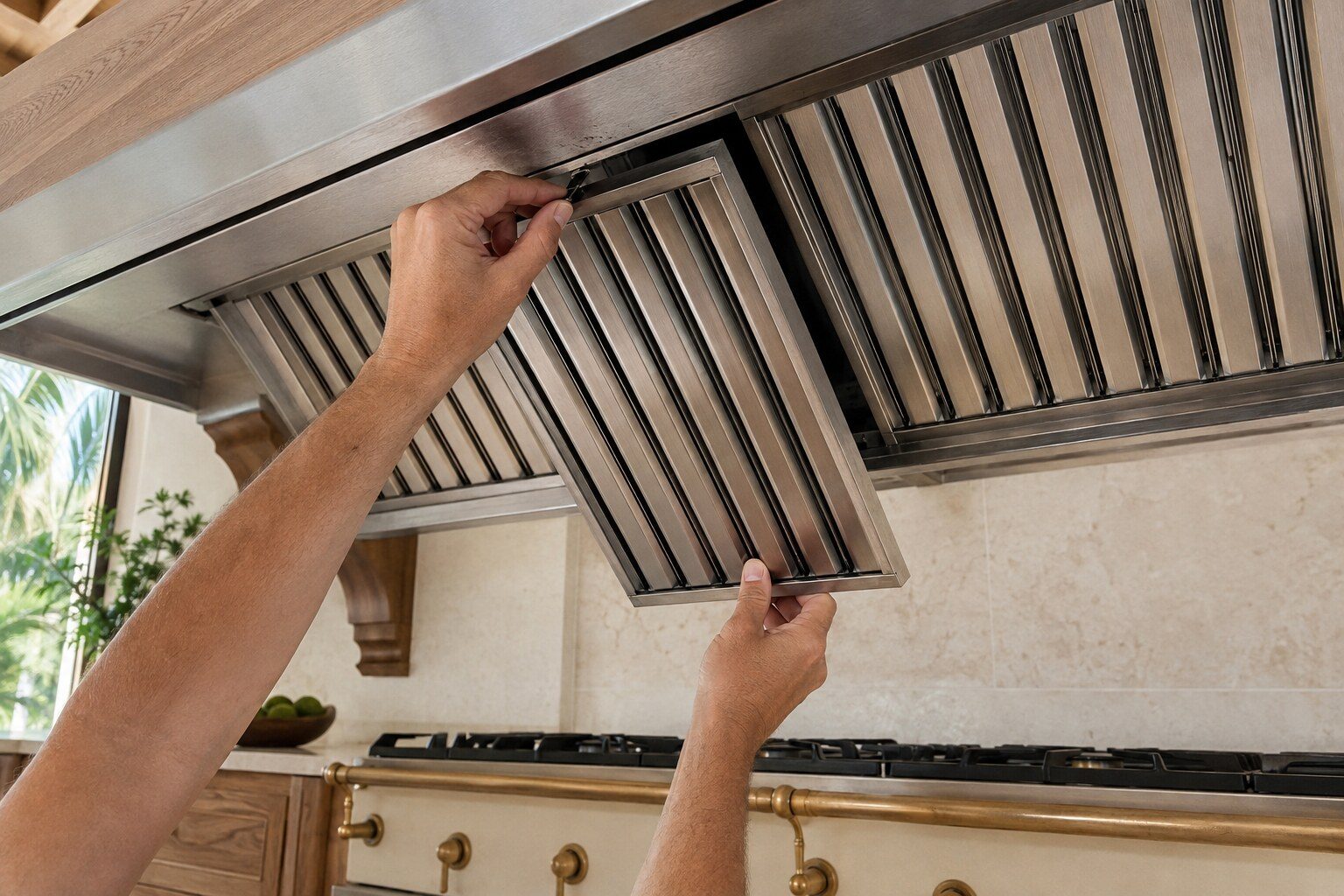
Maintenance & Prevention
How Often to Clean Hood Filters Over a Range Like This One
Every four to six weeks with real use, and monthly if you use the lava-rock grill or the plaque regularly. That is shorter than the general advice because of what is underneath: a 22,000 BTU power burner, a 14,500 BTU lava-rock grill, a cast-iron plate holding heat across its whole surface, and on the larger ranges a gas oven venting into the same room. La Cornue's hoods use baffle filters with a grease capture system rather than mesh, and they are dishwasher safe — so this is a free repair rather than a purchase. The channels and the capture tray behind the baffles want doing a few times a year, which is messier. And the reason it matters beyond comfort: the 600 CFM rating assumes an unobstructed six-inch duct, and grease the hood does not catch ends up in the cabinet under the cooktop where the induction generator lives, which is what the E2 overheating code is about.
The full guide
How often should you clean range hood filter? Why the general advice is wrong over this range
Most sources say every three to six months, and for most kitchens that is fine. Look at what is under this one.
A brass power burner at 22,000 BTU. A lava-rock grill running a linear burner at 14,500 BTU under a bed of rock soaked in fat. A cast-iron plaque holding heat across its whole surface with pans working all over it. And on the larger ranges, a gas oven venting into the same room.
That is a great deal more grease-laden air, produced far more often, in a climate where the windows stay shut and the air conditioning is running. Every four to six weeks with real use, and monthly if the grill or the plaque are part of how you cook.
The good news: it is free
La Cornue's motorized hoods use two dishwasher-safe baffle filters with a grease capture system, not mesh. That is a deliberate choice and it is the reason this maintenance costs nothing.
Baffles work by making the air change direction sharply so grease drops out and drains into a capture channel behind them. They catch more than mesh and they clean up completely — top rack, on their own, hot cycle. If they come out still tacky, they were overdue: degrease them in the sink with hot water first and run them again.
You do not have a charcoal filter. Charcoal belongs to a hood that recirculates air into the room, and these are ducted — 600 CFM against an unobstructed six-inch duct on the canopies, eight inches on the inserts. If anybody offers you a charcoal filter for one of these, check what you actually have first.
The parts behind the filters
Two jobs that are not the filters and get skipped for years.
The channels and the capture tray. Behind the baffles is the system that collects what they take out of the air, and it fills. A few times a year, and it is messier than the filters — gloves, hot water, patience.
The duct. Once a year, look up it with a torch with the baffles out. A film is normal. A lining you could scrape is a restriction, and so is a seized backdraft damper and a termination cap that has spent a decade collecting salt and grease on a coastal roof. That cap is the commonest hidden cause of faded extraction in a house near the water, and nobody ever looks at it because it is on the roof.
Why this protects the range, not just the room
This is the part worth knowing, and it changes how seriously people take the interval.
A hood running at half its rated flow does not simply make the kitchen smell. The grease it fails to catch goes onto the cabinets, onto the ceiling and — eventually — into the cabinet under the cooktop, which on an induction range is where the generator lives.
And the one overheating code La Cornue documents, E2, is about exactly that: the electronic unit is too hot, and the maker's own first suggestion is the installation of the cooker and whether there is sufficient ventilation.
So a neglected hood shortens the life of the most expensive electronic assembly in the range. Servicing the hood is looking after the range, which is why it is part of an annual maintenance visit here rather than something to attend to when somebody complains.
Two things that are not filters
A motor that has started to rumble. A bearing already worn, and the sequence from there is predictable: more noise, more current, a thermal trip, then a seized motor — usually on a day the kitchen is full. Fixing a rumble on a planned visit costs less than fixing a seizure at short notice.
One speed only. That is the four-speed control rather than the blower, and it is a distinct part. Worth fixing rather than living with, because the low speeds are what a hood is meant to run at while something simmers, and a hood nobody switches on because it is deafening is not protecting anything.
The interval, written down
Put it on the inside of a cupboard door:
- baffles — every four to six weeks, dishwasher;
- channels and capture tray — three or four times a year;
- duct and termination — looked at annually, cleaned when it needs it;
- blower current and all four speeds — measured at the annual service.
On a hood that starts at $17,400 and is enamelled to match the range beneath it, that is a very cheap maintenance schedule.
If it turns out to be a repair
What this leads to, and what it costs
Every job on this site is priced the same way: an on-site diagnostic first, the figure agreed in writing before anybody starts.
-
Hood filter and duct service
Faded suction with a motor that still sounds fine is almost never the motor. Baffle filters with a grease capture system are dishwasher safe, and the 600 CFM figure is specified against an unobstructed six-inch duct — eight on the inserts. Most of this job is the air path.
- Baffles cleaned or replaced first, because it costs nothing to rule out
- Duct run, damper and termination measured rather than assumed
- Airflow verified after the work, not promised
-
Hood suction has faded
Faded extraction with a motor that still sounds healthy is almost never the motor. The 600 CFM these hoods are rated at is specified against an unobstructed six-inch duct — eight inches on the inserts — and the baffle filters are dishwasher safe, so the first fix on this call is frequently free.
- Saturated baffles first, because they cost nothing to rule out
- 600 CFM assumes an unobstructed duct — most losses are in the run
- A coastal termination cap is a salt and grease trap
-
Range hoods
The hood over a La Cornue is not an accessory bought to match. A motorized Château hood starts at $17,400 for the 90 and runs past $25,000 for the Grand Palais 180, it is made in the same enamels and trims as the range, and it does real work: a 600 CFM blower on a four-speed variable motor, baffle filters with a grease capture system, three 20-watt lights and a remote. When one stops, the kitchen it was built for stops working properly.
- Motorized Château hoods, island hoods and inserts, plus the CornuFé collection
- 600 CFM blower, four-speed variable motor, baffle filters, remote control
- A hood is finished to match the range — the enamel is part of the repair
-
La Cornue cooktop error code E2
La Cornue cooktop error code E2: La Cornue error code E2 is the induction hob reporting that its own electronic unit has got too hot and has shut the cooking zones down to protect itself. Which machines can actually raise it, where the number lives on this make, and what to do next.
What this one means

Questions people ask about this
Can baffle filters really go in the dishwasher?
Yes, and that is why the hood has them rather than mesh. La Cornue specifies two dishwasher-safe baffle filters with a grease capture system on its motorized hoods. Top rack, no other dishes, and a hot cycle. If they come out still tacky, they were overdue — do them again or degrease them in the sink with hot water first.
Do I have a charcoal filter to replace as well?
On these hoods, no. A charcoal filter belongs to a hood that recirculates air back into the room instead of ducting it outside, and La Cornue's hoods are ducted — 600 CFM against a six-inch duct on the canopies and eight inches on the inserts. If somebody has sold you a charcoal filter for one of these, check what you actually have before fitting it.
Suction has faded and the baffles look clean.
Then it is the rest of the air path, not the filters. In order: the channels and capture tray behind the baffles, the duct run itself, a seized backdraft damper, and a termination cap — which on a coastal roof is a salt and grease trap. Only when the path is proved clear is the blower or its capacitor worth suspecting.
Mine has two motors. Does that change anything?
It changes what a failure looks like. On the larger motorized canopies one blower can fail silently while the other carries the room, and the only symptom is a kitchen that takes twice as long to clear. So test each end, and if the hood has always cleared well and now does not, mention that it has two — both get checked while the canopy is open.
Maintenance & Prevention
More guides like this one
-
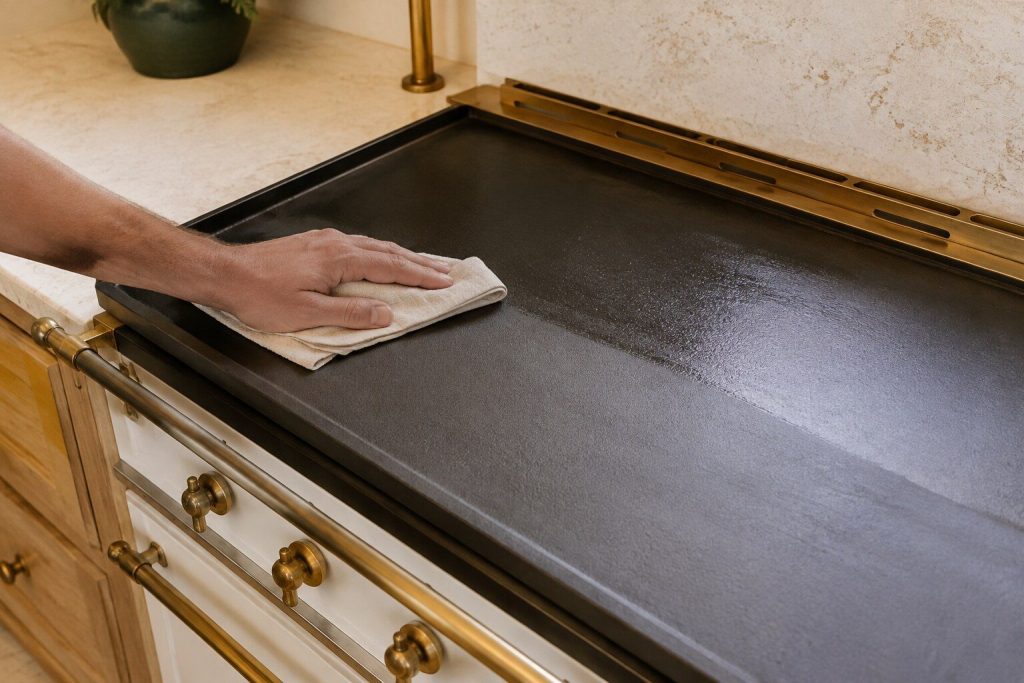
Seasoning a French Top, and the Mistake That Cracks One
Cast iron kept dry and seasoned outlives the kitchen. Washed down hot, it cracks — and a replacement plaque is a made-to-order part.
Read more -
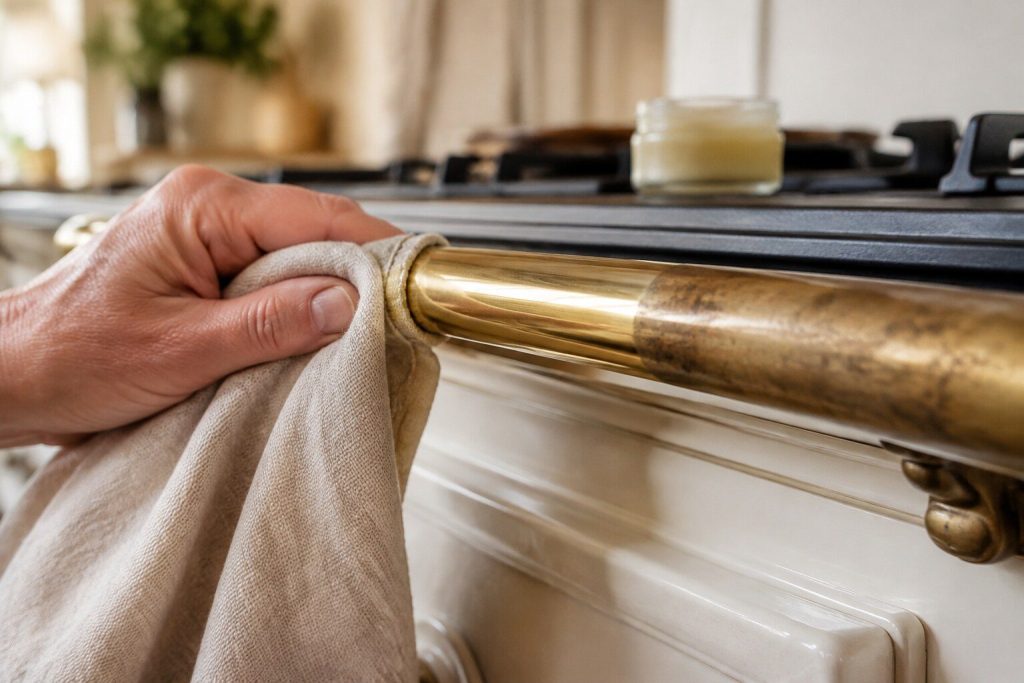
Cleaning La Cornue Brass and Trim in a Coastal Kitchen
Establish whether your trim is clear-coated before anything abrasive touches it. Removing lacquer along with tarnish is the mistake that cannot be undone.
Read more -
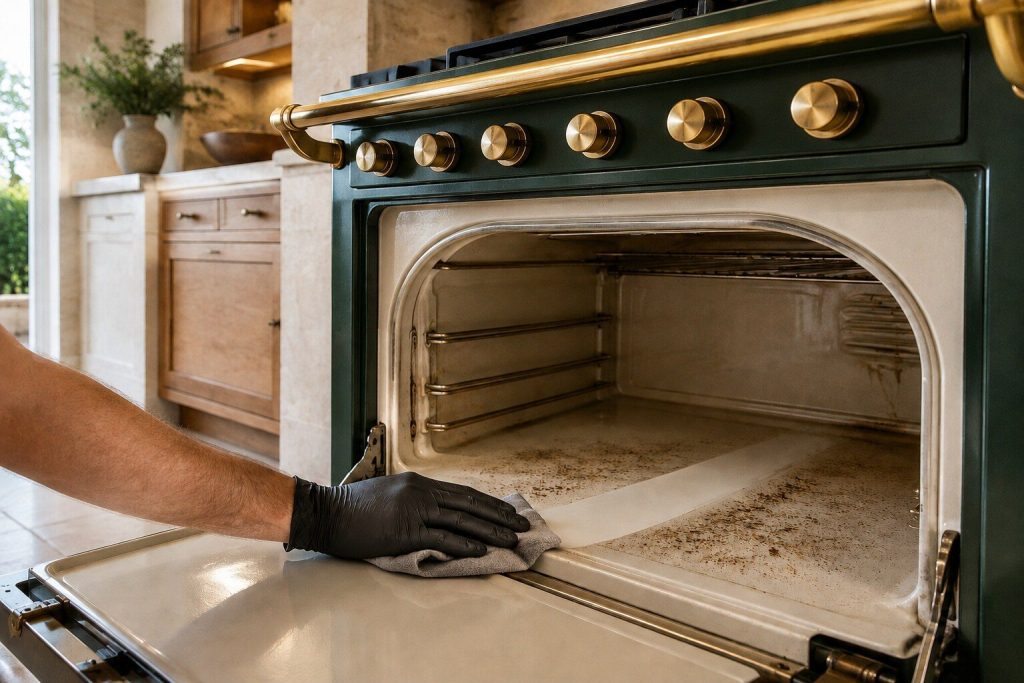
Cleaning a La Cornue Oven Without Damaging the Enamel
There is no self-clean cycle to fall back on, and the maker's own notes rule out corrosive and caustic cleaners. So it is patience and the right products, in the right order.
Read more
Tell us the model number and what it is doing.
This article is based on:
- Official manufacturer documentation
- Internal repair procedures
- Technician repair history
- Company quality standards